
Table of Contents
- Porto 2025!
- President's Corner: We Live to Meet
- President's Pointers for Porto
- Report of Program Committee, Porto 2025
- The ISHPSSB Porto Meeting is Just Around the Corner
- ISHPSSB 2025 Nominations
- Student Advisory Committee Updates
- Membership Development Committee (MDC) Report
- Center for Biology and Society at ASU Celebrates 20 Years of the Embryo Project
- The 2025 JAS-BIO Meeting in Rice University, Houston, Texas
- Sandra G. Harding (1935–2025)
- Interview with Jörg Matthias Determann (first part of two)
- Report of the Off Year Workshop Committee
- Report from the Education Committee
- Calls for jobs and fellowships
- Credits
Porto 2025!

President's Corner: We Live to Meet
Every two years we come together to share our work, exchange ideas, see old friends and make new ones. Nearly all academic organizations have some kind of meeting like this, often on an annual basis, but ours are different, and quite distinct. We are not discipline-defined, but multi-disciplinary, and keen to enable interdisciplinary configurations or even transdisciplinary approaches. We celebrate this, recognizing interdisciplinarity formally with an award given at each biennial meeting, and we egg each other on, encouraging new areas of inquiry, trying new and daring approaches, and providing fertile ground for future collaborations. We go well out of our way to do this, providing a supportive community, and are especially welcoming to graduate students, early career and independent scholars, or anyone attending for the first time, and on an international scale. In short, our meetings are inclusive, engaging, informal, and fun. Indeed, the society was formed and continues to flourish precisely to facilitate such meetings. It may not be our formal motto (though it ought to be) and no exaggeration, that “we live to meet.” This is the truth!
 Local Arrangements Chair Maria Strecht Almeida and Program Committee Co-Chair, Charles Pence pointing to the magnificent view near our meeting site at the Crystal Gardens.
So, as we would expect, there is excitement in the air. We are a couple of months away from our meetings in Porto, Portugal, in what is unquestionably an exciting locale. Our local arrangements team, led by Maria Strecht Almeida has been hard at work, carefully planning for our comfort, and safety, and making sure that we experience the best of this historic city, and learn about Portuguese history and culture at the same time we share our work. Our program committee led by Kate MacCord and Charles Pence has also been hard at work, putting together an especially inclusive, diverse, and exciting program. It is jam-packed with papers and sessions and keynotes that are guaranteed to provide us with inspirational talks and lively exchanges for five straight days. I don't know if it is the biggest program we've ever seen in ISHPSSB, but it sure feels that way, at least to me—there is literally something in it for everyone. Council, which includes the Executive, has been carefully following both the local arrangements and the program, and has met on a regular schedule, but has been especially vigilant in tracking the rapidly shifting geopolitical, economic and travel dynamics that might affect the meetings.
 Charles Pence in front of our meeting site, ICBAS (School of Medicine and Biological Sciences) at the University of Porto (right next to the Crystal Gardens).
I also give high marks to our Treasurer Don Opitz, and the Travel Support Committee for their hard work these last few months that have been full of unexpected and undue challenges. Not only did they distribute funds in support of travel once, as is usually done, but they opened a second call, after we learned that some conference participants had unexpectedly lost not just their funding, but also their jobs, becoming independent scholars in what seemed an eyeblink. This will cut into our finances, of course, but we thought it important enough to the success of the meetings to do this, and we have redoubled our efforts to raise funds and recoup the costs. That is why we ask those of us still doing well to please contribute to the travel fund whatever we can, even if it doesn't seem like a lot; every little bit will help make the meeting a success and welcome for all (and a huge thanks to those who have already done so). In the meantime, Don Opitz and our ad hoc fundraising committee will shortly roll out their campaign to help grow our endowment, which we view as essential to ensuring the inclusivity, vitality, and future of the organization. Finally, we have worked hard to keep meeting costs low, using a “sliding scale” for conference fees, and Porto, itself offers a diversity of food and lodging for every budget. There is a lot of “bang for one's buck”, in other words, as I hope you will see.
 The Super Bock Arena and Crystal Gardens where we will have some of our larger events on the Thursday (watch out for the resident chickens, roosters and peacocks).
And there is more happening: our nomination committee led by Rachel Ankeny, our past-president, has assembled a slate of nominees for new officers of the organization (a big thank you to Rachel and the committee, and to all those willing to take on this important work), and we urge all the membership to vote. We will share even more news and developments from our committees in Porto, especially at the Members' Meeting on Thursday morning, and hope that you will join us to offer your ideas, and to volunteer for committees that need new and energetic members. We will also hold a special recognition ceremony to honor outstanding individuals and their contributions to the organization, as well as to remember and appreciate the lives and work of members who are no longer with us on Thursday afternoon. And we will wrap it all up with a delicious Portuguese dinner, in the Palácio da Bolsa, the famous old stock exchange, a spectacular setting right in the middle of historic Porto, a UNESCO world heritage site. How often do we get to do that?
 Historic Porto with one of its many bridges.
By now, I think you likely can tell: I am as excited as could be. It will, of course, end with a twinge of sadness for me because it will mark the end of two wonderful years that I've enjoyed working with many of you. It sounds like a cliché, but it happens to be heartfelt and true, that it has been an honor and a pleasure to serve in this organization which has been in my life in some capacity for only the last 43 (!) years now, though it was in an inchoate version when I first encountered it. I'm certainly grateful to everyone who has made it more pleasure than work: the membership, and especially to the many volunteers and contributors to the organization, and the committee members, the Council, and the cheerful and energetic Executive comprised of Don, Charles and Kate, as well as our trusty secretary, Lloyd Ackert, and Sabina Leonelli our president-elect. Most of all, I'm grateful to the planners of this meeting, a veritable “dream team” of Maria, Charles, Kate, and Don, who have made it incredibly fun (look at some of the photos to see what I mean) as well as to our superb communications team of Lucie Laplane, Michel Durinx, and of course David Suarez Pascal getting the word out. David has been especially generous with his time, and in putting up with endless delays and editorial interventions from contributors like me. I hope I'll get to say thanks to all of them, and to you in person, soon, but until then, I raise a glass of Vinho verde, Portugal's famous “green wine” to our very special multi-lettered, multi-disciplinary society: may we live to meet in perpetuity. I wish safe travels to all who will meet in Porto, and until then, saùde!
Betty Smocovitis, President
President's Pointers for Porto
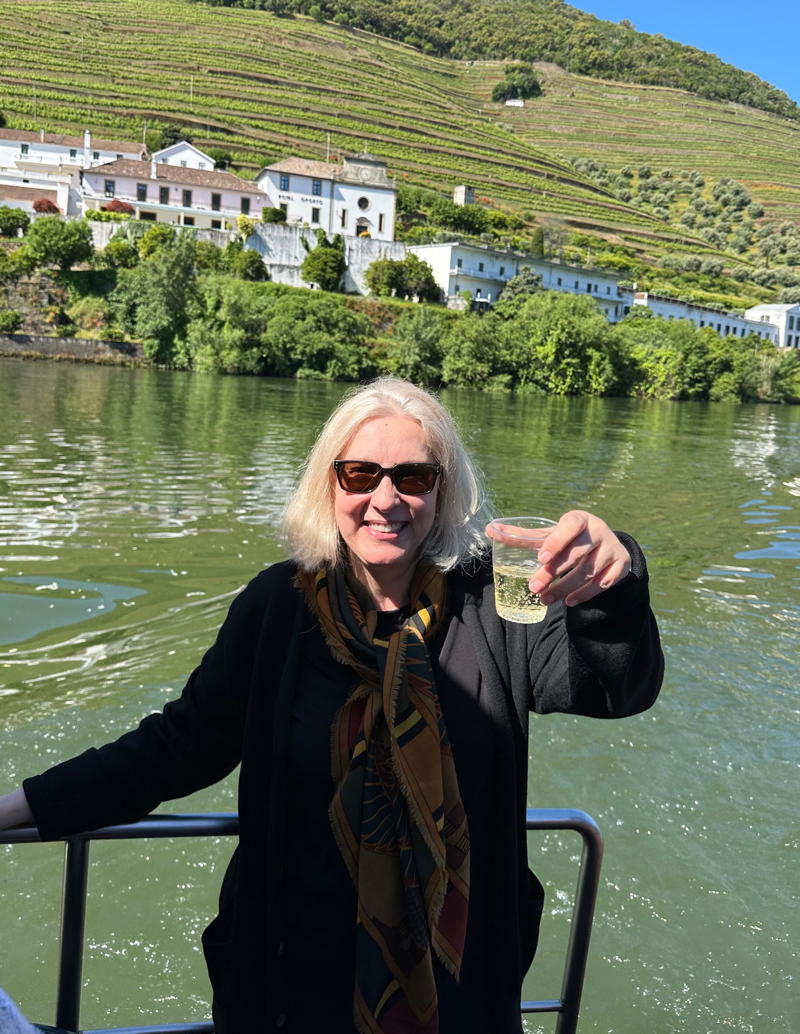 Toasting to all, in the Douro Valley with Vinho verde.
We chose Porto (also known as Oporto) for our 2025 meetings not just because of the conference amenities but also because of its rich history, stunning beauty, and because it was comparatively affordable, especially for a world-class tourist site in Europe. It is also an easy city to access, by airplane, train, or car, and easy to navigate on one's own; there are inexpensive taxis and buses to take you most everywhere, though places in the historic center are best accessed on foot. The historic center is packed with museums of different kinds, churches, and stunning examples of the distinct architecture of Portugal from different periods of time. The tilework alone on both the outside and the inside of many of the buildings, especially the train station, and at the Porto Cathedral is impressive and worth a close look. Porto is also full of both funky and elegant cafés, bistros and restaurants for every budget, from cheaper street fare, to smaller bistros and neighborhood restaurants, to multiple Michelin-star gourmet restaurants. It is unquestionably one of the great food and wine cities in the world, drawing devoted foodies and wine connoisseurs from practically everywhere. The city market alone is worth a visit. It is full of spectacular delights that are so beautifully displayed that it itself is a work of art just as much as it is a place to eat and shop.
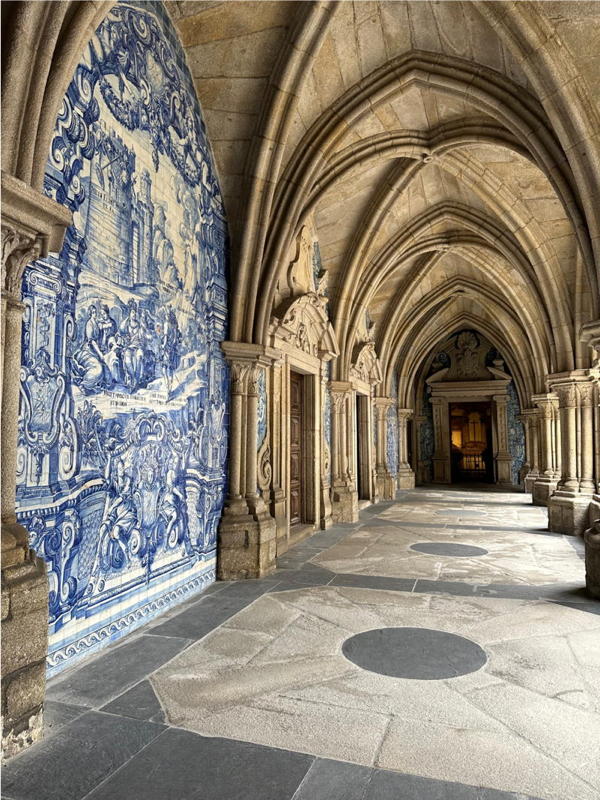 Tilework and magnificent Gothic arches in the cloister of Porto Cathedral. This is a must see, and do buy tickets to see the opulence of the Bishops' Quarters or Episcopal Palace (worth it).
A very old port city (Vasco da Gama and Magellan set sail from here), Porto is filled with grandeur especially in its Gothic churches, Baroque interiors, and tall church spires. Its opulence is, however, due to the riches of an enormous and expanding empire (sixteenth century Portugal was considered one of the most prosperous places on earth; but the spoils of the colonial empire are evident still). Parts of the old city are also full of mystery and intrigue (at least to me) with narrow, winding streets up and down steep hills with magnificent rooftop views over the Douro River. There are no less than six bridges spanning this historic river, full of barges and boats on most days, with its banks lined with beautiful cafés and promenades. Porto also includes a number of formal gardens such as the historic Porto Botanical Garden surrounding the Hall of Biodiversity where we will meet, along with the Crystal Gardens and Super Bock Arena where we will have all our events on the Thursday (watch out for the many chickens, roosters and peacocks that make their home there). For those keen on nightlife and bars and music, there is Fado, the distinct music of Portugal (offbeat places are best to get the full effect).
 A Porto beachfront
Portugal is often considered part of the Mediterranean, though it doesn't even touch the Mediterranean Sea, and instead borders the North Atlantic. Porto itself has moderate temperatures, and is much cooler than the Mediterranean in July, but heat waves are not uncommon, so visitors should be prepared for that. Fortunately, Porto also has some wonderful beaches for swimming or sunbathing with tall shady Casuarina trees, introduced from Australia, if it does get too hot.
 The terraced vineyards of the Douro Valley.
 Carnations celebrating the “Carnation Revolution” (1974) in storefront window.
Finally, if you see carnations painted on murals or displayed in storefront windows, that is because the flowers represent the “Carnation Revolution,” a bloodless coup that ended a forty-year dictatorship of Portugal. The 50-year anniversary was last year, but it is still remembered and celebrated as one of the most important and defining moments in modern Portuguese history. Let that be an inspiration to us in 2025.
Betty Smocovitis, President
Some quick travel pointers here:
- Porto's steep hills, cobblestone streets, and historic lanes and paths may be especially challenging for those of us with mobility or other health issues. I strongly recommend non-skid, comfortable walking shoes, and if it proves too difficult, the use of taxicabs to get around (taxi stands are everywhere and taxis are fairly inexpensive).
-
Layered garments are best: we will have air-conditioning in our conference rooms so may need light covering for that, but we may also experience a heat-wave in July (expect almost everything with climate change). We expect it to be dry but it never hurts to bring a small travel umbrella.
 Maria Strecht Almeida and Charles Pence choose from the extensive beverage list at the elegant Majestic Café (pricey but worth it and worth the Belle-Epoque experience).
 Maria Strecht Almeida and Charles Pence trying out one of the famous dishes associated with Porto, the Franscesinha.
 - The HF Hotels near our conference site are comfortable, clean and safe, as well as reasonably priced. They also have feast-like breakfasts so sign up for those; actually, sign up for any Portuguese breakfast if your lodging offers it, because they are a delight.
- Restaurants offer an array of seafood for those of us who love the stuff (cod is really big as you would expect, but also the smaller fish prepared many different ways). The food best associated with Porto, however, also includes a dish made of cow tripe translated as “Porto tripe” and a meat-lover's, saucy sandwich called the “Franscesinha” or “the little Frenchie.” Yes, there are plenty vegetarian and vegan options too. I'm not going to say much about the obvious: sample the Port wine (if you are like me, you will likely to be amazed at so many variations on the theme).
- Avoid day tours booked with platforms like Viator, which take an appreciable cut from both you and the local tourist operator. Our local arrangement chair, Maria Strecht Almeida provides information on discounts for tours in her report in this newsletter. I used Oporto Sensation and was happy with them: (https://www.oportosensationstour.com/
- The best thing you can do in Porto is put on your comfortable shoes and walk around stopping to admire the place, and visiting as many museums as you can. I am especially keen on the University of Porto's Natural History and Science Museum, parts of which may still be under reconstruction, but which is stellar. Its collections go back to the 18th century especially in botany, zoology, paleontology, but even anthropology as well as in its collections of laboratory instruments and teaching models. You can appreciate Portugal's imperial reach in the many collections from places such as East Timor, Mozambique, and Angola (you can see some of this reach in the Porto Botanical Garden too).
I hope you enjoy some of this, and even more (some photos for you here).
Report of Program Committee, Porto 2025
When the November 1 deadline for submission passed, the Program Committee powered through the task of evaluating over 700 submissions, including 20+ posters, from scholars around the world. In late January, we were delighted to send out acceptances for nearly every proposal submitted, leaving the committee with a staggering 200+ sessions to organize across five full days of conference time. With 13 rooms running concurrent sessions, the diversity of topics is staggering: from Aristotle to Michael Levin, from agency to pluralism, from gender studies to experimental results, the presentations represent the full range of what it means to be ISHPSSB. In addition to a plenary provided by world-renowned science writer Phillip Ball, the Program Committee has been working to bring new events that highlight the range of ISHPSSB scholarship, including two, new mini plenary sessions in which two duos of scholars will dive into their perspectives on hot topics: ocean conservation and invasion. In the meantime, we're working hard to finalize the schedule, pull together a full program, and ensure that everyone attending ISHPSSB gets the full ISH-experience. More updates are coming soon, so be sure to keep an eye on the conference website and your email.
Kate MacCord and Charles Pence,
Program Committee Co-Chairs
The ISHPSSB Porto Meeting is Just Around the Corner
With just under two months to go for the opening of the 2025 ISHPSSB biennial meeting, most things are taking shape.
 Hall of Biodiversity, University of Porto
The meeting will start on Sunday 20 July, at 6 PM at the Hall of Biodiversity with a welcome reception (welcome speeches and social events, including science center and botanical garden visits and—of course—a “Porto de Honra”). The building is part of the Natural History and Science Museum of the University of Porto.
From Monday, 21 July, to Friday, 25 July, most of the sessions are planned to take place at the School of Medicine and Biomedical Sciences (ICBAS) of the University of Porto. ICBAS is located at the Central Campus of the University, downtown. The conference benefits from the proximity of ICBAS with the Super Bock Arena Conference Center, where Thursday's plenary session and other sessions scheduled for that day will take place.
The Conference Dinner is scheduled for the evening of 24 July at the Hall of Nations, Palácio da Bolsa. We are working towards an inclusive and informal social event. Please note you will need to specifically register for the dinner.
Meanwhile, the meeting registration is open now, the deadline for early registration being 1 June. After this date, registration will be possible until 10 July at an increased fee. Participants can register for the Conference Dinner at the time of the meeting registration, or later (but not on-site).
ISHPSSB Meetings are known for being child-friendly. A basic childcare room will be available at the main conference venue, ICBAS, including a baby changing table, a crib, as well as a nursing chair for participants who are breastfeeding. For older children, a list of activities taking place in the city during the conference will be made available in advance. We are still working on this.
We are committed to environmental sustainability and minimizing the environmental impact of our event. In this sense, we will take care to reduce the amount of paper and disposable materials we use. We will provide all participants with reusable cups that we ask you to remember to bring with you every day. There will be water dispensers near the parallel sessions' rooms.
Coming to Porto for the 2025 ISHPSSB Meeting is, in addition to the conference, an opportunity to explore the region. You may be interested in taking a look at the Visit Porto and North Marketplace (https://booking.visitportoandnorth.travel/en/), a platform for marketing tourism experiences and activities in the Porto and North region of Portugal. ISHPSSB Meeting participants who wish, will be able to book a wide variety of tourist activities in this platform with a 10% discount—the promocode will be sent by email upon meeting registration. All the experiences included in the Marketplace have the official guarantee of Turismo do Porto e Norte. The conference local organizers are not endorsing or taking responsibility for any of these service providers. You may also be interested in considering the advantages of the Porto.CARD (https://booking.visitportoandnorth.travel/en/portocard/), the official card of the city of Porto. ISHPSSB Meeting participants will receive 10% discount on the purchase of the card, using the same promotional code.
Our website (https://ishpssb2025.icbas.up.pt) is being updated frequently, we encourage you to regularly explore the information shared there.
Looking forward to welcoming you to Porto!
Até já,
Maria Strecht Almeida,
Local Arrangements Committee Chair
ISHPSSB 2025 Nominations
Many of our members are going through difficult times at their institutions and in their countries, due to social, political, economic, and other issues. These circumstances made composing a slate especially challenging, and we are very grateful to all who were willing to stand for election. We also were comforted by the strong support of so many people (including those without capacity to be nominated at this time) for ISHPSSB and its mandate.
I wish to thank those who submitted nominations and the members of the Nominating Committee for their service: Marina DiMarco, Ageliki Lefkaditou, Thomas Pradeu, María Jesús Santesmases, and Francisco Vergara-Silva.
Rachel A. Ankeny,
Nominations Committee Chair
2025 ISHPSSB Election Slate
All candidates are listed in alphabetic order by surname.
President-Elect
- Nick Hopwood
- Francesca Merlin
Council
- Tatjana Buklijas
- Stefano Canali
- Arantza Etxeberria
- Lucie Laplane
- Kate MacCord
- Kärin Nickelsen
- James Stark
- Rob Wilson
Program Committee Co-Chairs
- Maria Elice de Brzezinski Prestes
- Yafeng Shan
President-Elect
Nick Hopwood1
 A historian of biology, medicine and their visual cultures, Nick Hopwood has been much involved in cross-disciplinary networking and in postgraduate and postdoctoral training locally and internationally. Once a developmental biologist, he is now Professor of History of Science and Medicine at Cambridge HPS, co-chair of the Interdisciplinary Research Centre Cambridge Reproduction and co-director of the Ischia Summer School on the History of the Life Sciences. He is the author, among other works, of Haeckel's Embryos: Images, Evolution and Fraud (Chicago, 2015). Collaborative research includes Models: The Third Dimension of Science (Stanford, 2004), Reproduction: Antiquity to the Present Day (Cambridge, 2018) and, most recently, ‘Cycles and Circulation: A Theme in the History of Biology and Medicine' (HPLS, 2021).
Nick has benefited from ISHPSSB meetings since Leuven (1995) and has served on council and the nominations, operations, and Hull Prize committees. During challenging times for projects promoting social justice in and around biology, he would work as President to maintain and extend the cross-disciplinarity, internationality and other forms of inclusivity that have made ISH a vital and fun forum for critical reflection on the life sciences.
Francesca Merlin2
 I have a PhD in philosophy (University of Paris 1 Panthéon Sorbonne, 2009) and I am a permanent researcher in the philosophy of science at the CNRS and director of the IHPST laboratory. My research focuses on central concepts in biology such as chance and probability, inheritance, reproduction and epigenetics, both from a developmental and an evolutionary point of view. More recently, I have opened my research to biomedical issues such as the conceptualization of the environment in relation to health. From 2018 to 2024, I was President of the Société de philosophie des sciences (SPS). In 2019, I received the bronze medal of the CNRS.
I have attended almost all the ISHPSSB meetings since the first year of my PhD. My first one was in Exeter in 2007 and I was a member of the organizing committee of ISHPSSB 2013 in Montpellier. ISHPSSB is ‘the' meeting I look forward to because of the wide variety of topics and approaches that make its programme representative of current studies in biology, and also because of its friendly atmosphere. In line with my own research, which I try to make as interdisciplinary as possible, I would like to involve more and more historians and social scientists in the activities of ISHPSSB in the future, because it is a real added value for all of us as researchers to interact with colleagues who have different approaches to the study of biology.
Council
Tatjana Bujkilas3
 Originally trained as a physician in my home country, Croatia, I completed my PhD at University of Cambridge Department of History and Philosophy of Science and moved to New Zealand in 2008, where I have had a varied and interdisciplinary career at Waipapa Taumata Rau University of Auckland. Much of my research has been in history of medicine, from history of anatomy to the histories of developmental and reproductive sciences including, and especially, developmental origins of health and disease and epigenetics, and on some of these topics I've worked closely with developmental scientists. More recently, I have started to work in the broader area of the relationship between science and democracy especially in settler colonies with Indigenous communities.
I've been a member of ISHPSSB for over two decades, since my graduate student years. More recently, at Oslo 2019 conference, the panel that Jan Baedke and I co-organized won the Interdisciplinary Prize and I served as the program co-chair (with Jan Baedke) for Toronto conference in 2023. I'd like to see the ISHPSSB gain more visibility and membership in Asia-Pacific where, except for Australia and New Zealand, it is still relatively unknown. I would also like to see the ISHPSSB establish stronger links and collaboration with various disciplinary communities that share issues of concern with ISHPSSB, from historians, political and social scientists and Indigenous scholars, enriching and diversifying the topics and approaches of ISHPSSB.
Stefano Canali4
 I work in philosophy of science and medicine, with a focus on the epistemic role of technology and its ethical and social implications (particularly digital technologies, data, machine learning). With a background in philosophy of science and science and technology studies, in my work I use a philosophy of science in practice approach and engage in collaborations with scientists and engineers. Currently, I am assistant professor at the Department of Electronics, Information and Bioengineering of Politecnico di Milano (Italy).
I have been attending to ISH since the start of my PhD and the approach of the Society and the conferences has had a lasting impact on my work, welcoming my work despite the doubts I had/have and pushing me closer to scientific practice and interdisciplinary collaborations. In the future, I would like to create more connections with philosophers based in interdisciplinary universities/departments/groups, with events and resources on teaching non-philosophy students, establishing collaborations, and understanding contributions for philosophy and science. I would also like to seek ways to connect the Society with local networks, initiatives, reading groups in philosophy of biology and medicine.
Arantza Etxeberria5
 Dr. Arantza Etxeberria is a Professor of Philosophy of Science at the University of the Basque Country and a member of the IAS Research Group on Life, Mind, and Society. Her research explores the philosophical complexities of biological organization, autonomy, and individuality with a particular focus on reproduction and developmental evolution. Taking an organismal-relational approach, she examines these ideas in both natural and artificial contexts. Her recent publications cover topics like biological reproduction, pregnancy, evo-devo, and environmental conceptualizations.
I got to know the ISHPSSB in 1995, when I attended the Leuven meeting, and have since participated in many of its meetings. As a scholar in the philosophy of biology, I value ISH as a space to engage with key topics from diverse perspectives and to connect with colleagues across diverse geographic and disciplinary backgrounds. The Society provides a special milieu for creating a space for younger or novel scholars, fostering an equitable atmosphere. In my view, the Council should continue to enable and strengthen those collaborations and opportunities, and to support exciting, innovative projects with strong social potential and a positive impact on the broader community.
Lucie Laplane6
 Lucie Laplane is a philosopher of biology. She also has a masters in stem cell biology. Her research focuses on cancer, which she tries to approach through a mix of methods (philosophy, experimental biology and bioinformatics, mathematical modeling).
Her first ISH was in 2011 (Salt Lake City), and it ever since remained her favorite philosophy of science conference. More interdisciplinary, more welcoming, and less conventional than other conferences: it's a space where we can all invent and decide what history and philosophy of biology can be. She is active in ISHSSPB, including on the Editorial Board where she serves as Listserv Editor.
Kate MacCord7
 I am a historian and philosopher of biology, working on scientific understandings of sex (germ) cells—from their historical origins to their modern repercussions. I am an Assistant Teaching Professor in the School of Life Sciences at Arizona State University, and for the past eight years have co-run the McDonnell Initiative at the Marine Biological Laboratory with Jane Maienschein, bringing historians, philosophers, and biologists together to understand regeneration.
My first ISH meeting was Salt Lake City (2011), where I gave my first graduate student talk. There I met Scott Gilbert, who helped connect me with a laboratory in Finland and earn a Fulbright to spend a year living and working amongst the scientists there. I've been a member of ISH ever since, attending to give presentations as often as funding allowed. I've organized sessions, served on the Prize Committee, and currently serve as the Program Co-Chair for the Porto meeting. ISH is my “home” society, the space where interesting ideas roam and disciplines dissolve, and I would be honored to serve its members further.
Kärin Nickelsen8
 I am currently professor in history of science at LMU Munich, after having completed graduate studies in the Department of Philosophy in Berne, Switzerland, and a diploma in biology at the University of Göttingen. This trajectory has sensitised me to differences in academic cultures, and has shaped my research interests in many ways. I have worked on a variety of topics in the history of biological sciences, especially botany and plant physiology in the modern period (18th–20th centuries), and within these areas I am particularly interested in questions of historical epistemology and methodology, the history of collective research heuristics, and practices of collaboration and competition within and across disciplinary boundaries.
Given my own interdisciplinary profile, I have long been attracted to ISH and its mission: fostering dialogue between very different scholarly communities—that is, biologists, historians, philosophers, and social scientists—with intellectual curiosity, and in a friendly and inclusive atmosphere. To me, this agenda seems now more important than ever. I would be honoured to collaborate with other council members to continue this tradition, and especially strengthen the voice of historians in this productive diversity of perspectives.
James Stark9
 I am currently Professor of Medical Humanities at the University of Leeds in the UK where I am also Director of the Centre for History & Philosophy of Science. After studying natural sciences and specialising in physiology, I became hooked on the historical development of the biological and biomedical sciences. My past research includes work on antireductionism in the history of biology, histories of infectious disease and pathogens, and the history of ageing and anti-ageing, including two books (The Making of Modern Anthrax and The Cult of Youth). I am now working on a project exploring the histories and meanings of culture collections as pieces of biological research infrastructure.
The 2007 ISH meeting in Exeter was my first ever academic conference, when I organised a panel on biological reductionism as a graduate student. I remember how stimulating and welcoming the atmosphere was, and that is something that I am passionate about maintaining. Since then, I have served as the Chair of the Outreach and Engagement Committee with the British Society for the History of Science (2013–17), a member of the Programme Committee for ICHOTEC (2015–19), and Reviews Editor of the British Journal for the History of Science (2017–19). In all these roles I have worked hard to celebrate our researchers, bring together new possibilities for collaboration, and support early-career scholars. At a time when our ISH community has so much to bring to the global challenges we face I would be a champion for the field and its importance.
Rob Wilson10
 My research and teaching spans the cognitive, biological, and social sciences and my chief publications include Boundaries of the Mind (Cambridge, 2004), Genes and the Agents of Life (Cambridge, 2005), The Eugenic Mind Project (MIT Press, 2018), and Kin Matters (Oxford, in press). I have taught at Queen's University and the University of Alberta (both in Canada), the University of Illinois, Urbana-Champaign (USA), and La Trobe University and the University of Western Australia (in Australia). My general view is that, despite the mantras of interdisciplinarity and inclusion, our practices, especially in philosophy, too often result in research outputs and class offerings that are siloed and less inclusive than they might be.
I attended my first ISH meeting in 1997, was the program co-chair for the Montreal meeting in 2015, regularly attend and present at ISH meetings, and have served on several prize committees for ISH. The strength of the organisation lies in its power to facilitate graduate student and early career researcher development, as well as its truly international nature. As a Council member, I would aim to build on those strengths and look for ways that ISH can consolidate and extend what it does for scholars making their interdisciplinary pathway between history, philosophy, and the social studies of biology, especially in those important first 10 years.
Program Co-Chairs
Maria Elice de Brzezinski Prestes11
 Maria Elice is a historian of biology, whose work explores 17th- and 18th- century experimenters such as Francesco Redi and Lazzaro Spallanzani. More recently, her research has focused on questions of agency and teleology in these authors, as well as in Aristotle and Darwin. She is the author of Nature Investigation in Colonial Brazil (in Portuguese, 2000) and editor of Understanding Evolution in Darwin's Origin: The Emerging Context of Evolutionary Thinking (Springer, 2023). Maria Elice is one of the founders of the Brazilian Association for Philosophy and History of Biology (ABFHiB), established in 2006, and serves as a Board member and co-editor of its journal Filosofia e História da Biologia. As a senior (retired) professor at the University of São Paulo, she continues to teach and supervise research on the integration of the history of biology into science education.
Maria Elice has participated in ISHPSSB meetings for two decades, including those held in Guelph (2005), Exeter (2007), Montpellier (2013), and the virtual meeting based at Cold Spring Harbour (2021). She co-organized the ISHPSSB 2017 Meeting in São Paulo with Roberto de Andrade Martins. Over the years, she has served on various ISHPSSB committees, including Site Selection, Off-Year Workshop, Membership Development, Education, and David Hull Prize Committee, and has contributed as a voting member of the Council. She strongly feels that ISHPSSB fosters a uniquely collegial and productive environment that supports transdisciplinary engagement in the 21st century, and looks forward to continuing to foster this.
Yafeng Shan12
 Yafeng Shan is Associate Director of the Center for Philosophy of Science, The Hong Kong University of Science and Technology. He obtained his PhD in Philosophy of Science at University College London. He is mainly interested in general philosophy of science, history and philosophy of science, and epistemology. Since 2013, Yafeng has attended every ISH conference. Currently he is a co-chair of the 2025 Marjorie Grene & Werner Callebaut Prize Committes. He is devoted to promoting the international development of ISH (especially in Asia) and its collaboration with various regional associations (e.g. the Asian Philosophy of Science Association). He contends that ISH can better achieve its objectives by becoming a truly international organisation.
Student Advisory Committee Updates
The ISHPSSB Student Advisory Committee has undergone a name change to be inclusive of postdoctoral fellows and early career scholars. The new name is the Graduate and Early Career Committee, and the Executive Council voted unanimously in favor of the change! Thanks to committee members Leah Malamut and Fotis Tsiroukis, there is now a Discord server exclusively for ISHPSSB graduate students and early career members to connect over research ideas, common interests, and more! You may join via this link: https://discord.gg/kT9C75fsFx
At the meeting in Porto, the committee is organizing community-building activities to bring together old and new ISH members alike. We hope to have a room-of-refuge to allow for an escape from the hustle and bustle of conference life, and are also planning short walking excursions through Porto. Please join us for an activity, make new friends, and network with your fellow scholars. See you in Portugal!
Jarrett L. Joubert,
Graduate and Early Career Committee Chair
Membership Development Committee (MDC) Report
We regret to report that, due to significant health-related challenges—namely the MDC Chair's surgery in 2024 and ongoing family health issues affecting the Co-Chair—the committee has been unable to convene or carry out any activities since the Toronto meeting.
We are now preparing to resume our work in the lead-up to the July meeting in Porto, with a particular focus on activities related to the Interdisciplinary (InterD) Prize.
Although the MDC Chair will be unable to attend the Porto meeting, the Co-Chair will be present and plans to request a dedicated time slot in the program to reconvene MDC members. The goal will be to restart the four key initiatives that were identified as in progress in the 2023 report.
We appreciate the community's understanding and look forward to re-engaging with our work in the coming months.
Interdisciplinary Prize
In the last conference, we noticed that some extraordinary interdisciplinary sessions were not shortlisted because it is difficult to evaluate the merits of a session based only on title, description and abstracts. This year we would like to include an additional step of self-nomination to help the MDC in the pre-selection process. The process would be as follows:
Interdisciplinary (InterD) Prize Selection Process
Award Overview: The Interdisciplinary (InterD) Prize is awarded biannually by the Membership Development Committee (MDC). It recognizes outstanding sessions that exemplify interdisciplinarity—defined as the integration of methods and perspectives from two or more ISH disciplines (history, philosophy, and social studies) to generate insights that transcend any single field.
- Pre-Conference Pre-Selection Process
- Identification of Eligible Sessions
- Organizers indicate their session is interdisciplinary by ticking a designated box during submission.
- Review and Evaluation
- MDC scans sessions marked as interdisciplinary.
- Sessions are evaluated based on how well they integrate multiple ISH disciplines to address a problem in an interdisciplinary way.
- Self-Nomination (New Step)
- To improve evaluation, session organizers who wish to be considered for the prize are invited to submit a 200-word rationale explaining the interdisciplinary merits and originality of their session.
- Shortlisting
- Based on the initial review and self-nominations, the MDC shortlists sessions for prize consideration.
- Identification of Eligible Sessions
- During the Conference
- Session Attendance
- MDC members attend all shortlisted sessions.
- Ideally, two MDC members are assigned per session (dependent on MDC members' availability).
- Deliberation and Decision
- The MDC deliberates to select the InterD Prize winner.
- The winner is announced to ISH Council.
Vivette García-Deister and Abigail Nieves Delgado,
Membership Development Committee Co-ChairsCenter for Biology and Society at ASU Celebrates 20 Years of the Embryo Project
On Wednesday, February 26, 2025, the Center for Biology and Society (CBS) at Arizona State University hosted a reunion celebration in honor of the 20th anniversary of the Embryo Project (EP), a unique educational endeavor that blends the history of science with science communication.
CBS Director and 2025 History of Science Society Sarton Medalist Jane Maienschein launched the Embryo Project in 2005 with a small grant from the National Science Foundation, then nurtured it year after year with the help of ASU graduate students. The project received the History of Science Society's Joseph H. Hazen Education Prize in 2018, and Maienschein herself had received the Prize in 2000. Maienschein also received the David L. Hull Prize from Ishkabibble in 2015 partly for the Embryo Project.
Each semester, as part of the Project, Maienschein and two graduate students run a writing workshop devoted to helping students learn to craft deeply researched and trustworthy yet accessible articles for the Embryo Project Encyclopedia, an online educational resource that reaches millions of viewers every year. The topic is anything related to embryos, reproduction, and their context, and the articles are always historically grounded and interwoven with the science in ways characteristic of ISHPSSB.
The anniversary day's main event was a panel discussion with past Embryo Project instructors and editors, moderated by current Bio and Society PhD student and science writer/podcaster Risa Schnebly.
Several of the panelists spoke about how EP set them on the paths that they are following today, whether that's law, science writing, academic administration, or teaching. Others noted that the skills they learned in the writing seminar, such as not attributing mental states to historical actors, had stuck with them through their subsequent careers.
The panel discussants included:
- Alexis Abboud, PhD, JD, associate litigator with Wachtell, Lipton, Rosen & Katz in New York
- Katie Brind'Amour, PhD, science writer and founder of HealthWords, Ltd
- Kelle Dhein, PhD, assistant professor at ASU's School Complex Adaptive Systems
- Anna Guerrero, PhD, artist and postdoctoral fellow at the Santa Fe Institute
- Paige Madison, PhD, science writer, author, and fossil lover
- Erica O'Neil, PhD, project manager for the Lincoln Center for Applied Ethics at ASU
Kaitlyn Helm, a senior molecular biosciences and biotechnology major and current EP student who attended the event, said: “It was cool to see how many different avenues people went down. No one was doing the same thing.”
Pragalbha Ghatigar, a junior neuroscience major and current EP student who also attended the event, said: “I thought it was really interesting that they still use the skills that they learned from the Embryo Project in their jobs years and years later.”
Reflecting on the day, Maienschein said, “It's kind of humbling to think that when we started this project so long ago, we wondered whether it would last longer than our initial 3 year NSF grant. And here we are, hundreds of students and many hundreds of articles later!”
The 2025 JAS-BIO Meeting in Rice University, Houston, Texas
 Participants shown the extensive collections at the McGovern Historical Center and Archives in Houston, Texas.
The Joint Atlantic Seminar for the History of Biology headed southwest this year to gather on the beautiful campus of Rice University in Houston, Texas, USA, expanding the notion of the American Atlantic coast to the Gulf of Mexico.
"JAS-Bio" as the conference is affectionately known, is a one-day workshop that highlights the work of graduate students and early-career scholars, and provides a welcoming environment for younger scholars in the field of the history of biology to present on their research. For many students, it is the conference at which they deliver their first conference paper. For others, it is the first conference that they have ever attended.
 Gabriel Vanzo Rodrigues, Richard Creath and Jane Maienschein having a conversation in between the collections.
JAS-Bio, now in its 59th year, offers graduate students in the history of the life sciences the opportunity to present their work to a well-informed audience of faculty and fellow students in an informal and encouraging setting that connects an engaged community of relevant scholars drawn from key scholarly institutions across the Atlantic seaboard and beyond. With generations of JAS-Bio scholars returning to the meeting year after year, a culture of openness and mentorship has developed over the past six decades.
 Listening to the Papers
This year's event included twelve papers from students from ten American universities and two students from overseas universities (Korea and Germany), selected from twice as many submissions. The papers were grouped across four sessions: “Into the Field” (with papers on Indigenous botany in the Great Lakes region, Patagonian expeditions, and knowledge exchanges in the Atacama desert), “Of the Body” (with papers on Lamarckism in the French colonies, environmental physiology of women sea divers, and interwar typhoid vaccine bacteriology); “Languages of Life” (on new histories of C. elegans and those who studied it, Indian theories of degeneration, and the connections of linguistics with evolution); and “Realizing Biology” (with papers on ethology of aggression in the Kalahari, taphonomy in the Gulf Coast, and the many different human genome projects after the Human Genome Project).
 2025 JAS-BIO Official Portrait
The conference also included two fieldtrips to area archives that enabled students and faculty alike to experience first-hand about some of the archival treasures available in the Houston area at the Woodson Research Center at Rice University's Fondren Library, and the McGovern History Center of the Texas Medical Center, the largest medical complex in the world.
The event was supported by Rice University's Science and Technology Studies Program, the History Department, the Humanities Research Center, and a new fund, the JAS-Bio Trust at the Consortium for the History of Science, Technology, and Medicine. Together, these funds ensured that all accepted participants were able to have their domestic travel and lodging costs in Houston covered. We are grateful for the support.
Next year's JAS-Bio—the 60th edition!—will return to the East Coast, and will be held by our colleagues at Johns Hopkins University.
Luis Campos,
Baker College Chair for the History of Science, Technology, and Innovation History Department, Rice UniversitySandra G. Harding (1935–2025)
The philosophical and academic communities mourn the passing of Sandra G. Harding, an eminent scholar whose work transformed the fields of feminist and postcolonial theory, epistemology, research methodology, and the philosophy and social studies of science. Harding died on March 5, 2025, just weeks before her ninetieth birthday.
 Sandra Harding ©Emily Harding-Morick
Sandra Harding was born on 29 March 1935 in San Francisco, California, the first of five children of Lloyd and Constance Harding. Her father's struggle to find work during the Great Depression led the family to relocate to Los Angeles, where they operated a roadside diner until the outbreak of World War II. At that point, her father secured a civil service position, prompting another move, this time to the East Coast. Harding recounted experiencing sexism during her elementary and secondary education in New Jersey but remembered a warmly loving family environment that encouraged all the children—both daughters and son—to pursue their educational aspirations. Supporting her education through summer jobs as a waitress and at the telephone company, Harding attended Douglass College, where she studied literature.
After graduating, Harding moved to New York City, where she worked as a legal researcher, editor, and mathematics teacher. During this period, she met and married Harold Morick, a graduate student in philosophy at Columbia University. Following Morick's completion of his Ph.D., the couple settled in Albany, where he joined the philosophy department at the State University of New York. Together, they had two daughters, born a year apart. Amidst the momentum of the women's movement, Harding grew increasingly dissatisfied with the traditional role of a faculty wife. She joined the ranks of women pursuing advanced degrees, initially studying sociology at SUNY-Albany before transferring to New York University to pursue philosophy and earning her Ph.D. in Philosophy in 1973. Her dissertation focused on the epistemology of Willard Van Orman Quine.
Harding's first university teaching position was at the Allen Center at the State University of New York at Albany, an experimental critical social science college. It could be said that she began her pioneering work in feminist standpoint theory there, but Harding herself might have resisted the label “pioneering,” given its associations with whiteness, masculinity, and colonialism. Following an amicable divorce from Morick, Harding accepted a position at the University of Delaware. She also appreciated Wilmington's proximity to major urban centers like Philadelphia, New York, Baltimore, and Washington, D.C., which provided rich opportunities for networking and collaboration, including work for United Nations programs. While Harding encountered significant hostility within the department, particularly in the form of anti-feminist critiques, she nevertheless earned unanimous support for tenure—a testament to the strength of her scholarship. At Delaware, Harding expanded feminist standpoint theory to engage with the feminisms of Women of Color, valuing her growing connections with the Black intellectual community in the Northeast.
From 1994 to 1996, she split her time between the University of Delaware and the University of California, Los Angeles (UCLA), before accepting a full-time appointment at UCLA's Graduate School of Education. In 1996, she became Director of the UCLA Center for the Study of Women, a position she held until 2000. At UCLA, where she would eventually become Professor Emerita, she continued her engagement with professional organizations such as the American Philosophical Association, the Society for Women in Philosophy, and the Society for Social Studies of Science. She was co-editor of Signs: Journal of Women in Culture and Society from 2000 to 2005.
In 2012, she was appointed Distinguished Professor of Education and Gender Studies. From 2011, she also held an appointment as Distinguished Affiliate Professor in the Department of Philosophy at Michigan State University, East Lansing.
Harding held Visiting Professor appointments at the University of Amsterdam (1987), the Swiss Federal Institute of Technology Zurich (ETH) (1987), the University of Costa Rica (1990), and the Asian Institute of Technology, Bangkok (1994).
She was a consultant to several United Nations organizations, including the U.N. Commission on Science and Technology for Development, the Pan American Health Organization, UNESCO, and the U.N. Development Fund for Women. She was invited to co-edit a chapter of UNESCO's World Science Report (1996) on “The Gender Dimension of Science and Technology,” the first major international effort to highlight gender issues in science and technology. She later contributed to UNESCO's World Social Science Report (2010) with her chapter, “Standpoint Methodologies and Epistemologies: A Logic of Scientific Inquiry for People.”
Throughout her distinguished career, Harding lectured at over 300 academic and professional venues across North America, Europe, Africa, Asia, and Central America. Her writings have been translated into numerous languages and anthologized extensively, attesting to her global impact. Her leadership extended to editorial work, serving on the boards of multiple journals across philosophy, women's studies, science studies, and African philosophy.
Harding often reflected on the profound influence of social justice movements—including the women's movement, the civil rights movement, and decolonization struggles around the world—on her scholarship and activism. She remained steadfast in her commitment to producing work that would further the aims of these movements. Emphasizing a practical and managerial approach to writing, teaching, and mentoring, she often described herself as a “rogue philosopher” and delighted in Sharon Traweek's description of her as someone who “plants herself on the borders of institutions and refuses to go away.”
Sandra Harding's scholarship is best known for her formulation of “standpoint epistemology” and the concept of “strong objectivity”—innovations that have profoundly influenced feminist philosophy, science studies, and critical methodologies in the social sciences. By advocating for inquiry grounded in the lived experiences of marginalized communities, Harding challenged prevailing notions of objectivity and value-neutrality in dominant epistemological frameworks. Her work persistently interrogated the intersections of power, knowledge production, and social justice, offering foundational insights to feminist, anti-racist, multicultural, and postcolonial critiques of the sciences. As a tangible outcome of these intellectual commitments, Harding co-founded Tapuya: Latin American Science, Technology and Society alongside Latin American colleagues, contributing significantly to its development since 2016 and until her passing. It is fitting that Harding's final work is a co-edited volume with Tapuya's founding editor, Leandro Rodríguez-Medina, titled Decentralizing Knowledges: Essays on Distributed Agency (forthcoming from Duke University Press, June 2025). In this culminating space for interdisciplinary and collaborative inquiry, the editors convene a diverse range of voices to explore the infrastructures and practices that make non-hegemonic standpoints possible within academic fields, disciplines, and institutions—what Rodríguez-Medina and Harding termed epistemic decentralizing.
In 1986, she published The Science Question in Feminism, a landmark work in which she scrutinized the relationship between science, objectivity, and feminist critiques. Harding pointed out that science is the one discipline that expects its methods and descriptions of its own practice and motivations to be taken at face value—an expectation inconsistent with critical inquiry. She noted that feminism has had an ambivalent relationship with science: appealing to the ideal of objectivity while simultaneously exposing the ways scientific practices have been biased by gender, race, class, and sexuality. Harding distinguished between feminist critiques that aimed to correct “bad science” and broader critiques that questioned the very foundations of scientific methodology. She argued provocatively that science's history and structure have embodied masculine ideals of domination and control, and that feminist interventions could help bridge gaps between intellectual and emotional labor, enabling science—especially the life and social sciences—to become more responsive, comprehensive, and socially relevant. Physics and mathematics, long regarded as the paradigms of pure science, might eventually lose their privileged position, giving way to sciences more intimately engaged with human and ecological concerns. Feminism, Harding suggested, is not a threat to science but rather a necessary force for its maturation. During the “Science Wars” of the 1990s, her work became a focal point for debates over the social construction of scientific knowledge.
Harding also dedicated significant attention to the complex intersections of secularism, science, feminism, and postcolonial theory. She famously observed that “religion and science are almost always seen in opposition to one another,” yet insisted that secularism itself must be understood in its plural forms—different ways of being non-practicing, deeply shaped by cultural and religious histories. She cautioned against what she termed the “secularism tic” among educated elites, the tendency to dismiss the vital meanings and solidarities forged through religious experience. Harding emphasized how movements like U.S. civil rights activism and Latin American liberation theology revealed the progressive potential of religious traditions. Post-9/11 anti-Islamic discourses, she argued, posed urgent challenges for multicultural democracies, forcing a reevaluation of the meaning of secularism, inclusion, and religious tolerance. Throughout, Harding foregrounded women's complex and often transformative relationships with religious traditions, highlighting how feminist movements within Catholicism, Protestantism, Judaism, and Islam have sought both to improve women's conditions and to renew the religious institutions themselves. Her reflections underscored the need for democratic spaces where differences are preserved and mutual projects of solidarity are built—not simply through recognizing pre-existing commonalities, but by creating them through shared action.
In her final solo-authored work, Objectivity and Diversity: A New Logic of Scientific Inquiry (University of Chicago Press, 2015), Harding argued not only that objectivity and diversity need not be in conflict, but that rigorous research must be committed to both values simultaneously. The book draws on a wide range of scholarship, spanning twentieth-century philosophy of science to contemporary indigenous and postcolonial philosophy and activism. It is an intricate study of how objectivity, positivism, and secularism are profoundly intertwined with their social contexts and historical moments. Ultimately, the book advocates for a vision of science that both meets the methodological demands of strong objectivity and emerges organically from local communities.
In 2013, Harding was honored with the John Desmond Bernal Prize by the Society for the Social Studies of Science (4S) in recognition of her outstanding contributions to the field.
Sandra Harding's legacy feels especially urgent today, in an era when diversity, pluralism, and the critical capacities of science and higher education are increasingly under attack. As universities and scientific institutions face renewed pressures to retreat from their commitments to inclusivity, and as political movements seek to delegitimize the voices of marginalized groups, Harding's work offers a roadmap for why these commitments matter and a guide for building inclusive, transnational scholarly communities such as the one fostered by ISHPSSB. Her insistence that rigorous inquiry requires engagement with diverse standpoints, that strong objectivity is only possible through democratizing knowledge production, and that respect for difference is a condition for shared intellectual and political life, remains not only philosophically profound but also politically necessary.
In remembering Harding, we are called to uphold the open, critical, and pluralistic institutions she helped to shape—and to carry forward the work of imagining and enacting more just and inclusive ways of knowing together.
Siobhan Guerrero McManus and Vivette García Deister
Interview with Jörg Matthias Determann (first part of two)
 Matthias Determann © Kateryna Reshetova
Matthias Determann is Associate Professor at the Virginia Commonwealth University in Qatar, he studied history and Arabic in Vienna University and earned a Ph.D. from the School of Oriental and African Studies (SOAS), University of London. Recently, he edited a book titled Islamic Theology and Extraterrestrial Life (Bloomsbury, 2024), which highlights attitudes and interests from an Islamic perspective towards recent developments in astronomy and astrobiology, that touch upon issues that might be interesting for other members of ISHPSSB. Also, among his previous works, other one that might well be an obligated lecture is Researching Biology and Evolution in the Gulf States (Bloomsbury, 2015). Given our Society's aim to expand its reach and to diversify our membership and interests, we deemed showcasing the work of Matthias was a good opportunity to contritute to that goal.
David Suárez Pascal: Hello Matthias, thank you for accepting this interview. First, I would like to ask you some personal questions. How was it that you become interested in the Middle East and Arabic or Islamic culture and science?
Jörg Matthias Determann: Thank you so much. I was born in Munich, in Germany, and I grew up partly in Vienna, Austria. I didn't spend much time in the Middle East. When I grew up, however, I was very interested in the region, in the politics of the region, in the history of the region, especially as I was getting close to adulthood. So I was born in 1984, which maybe you can remember, because 1984 is also the title of a famous science fiction work. And I'm very, very interested in science fiction myself. So, born in 1984, I was finishing high school in 2003 and 2003 was also the year of the Iraq War. It was two years after 9/11, the September 11th attacks. It was also a year after the invasion of Afghanistan, and at that time the Middle East was really a very, very hot topic—just like it is now. Unfortunately, one has to say so just like nowadays, for instance, you can see a lot of young people in different countries being interested in Palestine, for instance, in the events of the Middle East, and Israel and Lebanon, and so on, and sort of being quite passionate about that subject.
20 years ago, already, I was similar to perhaps a lot of young people at that time, so I discussed the Middle East. I talked about Israel, Palestine, American politics in the Middle East. With my fellow students in high school, for instance, we had lots of debates, and so I got really interested in the region. I wanted to learn more about the region, so I studied Arabic at the University, in addition to history, and I spent more time in the region, first, in order to learn Arabic, and later to work there. So I have worked in Saudi Arabia, taught there at King Saud University in Riyadh. And for over 11 years now I've taught in Qatar, where I feel I am still there very much surrounded by a lot of the developments by a lot of the conflicts there. Qatar, even though it's quite a small place, is at the center of, a lot of the mediations in the conflict between Israelis and Palestinians, and so on. Thus, my interest in the Middle East at first had to do more with world politics and geopolitics and had very little to do with biology. Initially.
David Suárez Pascal: This takes me to to my second question, which is related to what you find more remarkable, surprising, or interesting, in becoming acquainted with the history of the Middle East, not from a Western perspective, but from a their own perspective.
Jörg Matthias Determann: Growing up in the West, growing up in Europe, I had mostly consumed Western media. So I wanted to learn more about the history of the region, from the perspective of the people who lived there. I wanted to learn more about the history of the Arab world, from books that were written by Arabs in Arabic. So my senior thesis in Arabic studies at the University of Vienna, was about the Crusades in Arab school books. I knew how the Crusades were taught in Western school books that I had read, but I really wanted to know how they were taught on the other side. And, for instance, what I found was that in the West the word crusade can be quite a positive word, quite a positive term like campaign against something that is bad. So, for instance, you could have a crusade against drugs, or you can have a crusade against crime, and so generally the word crusade would have a positive connotation like a worthwhile struggle. But looking at these Arab sources, I found that the Crusades had the connotation of the association of Colonialism, violence of massacres; and I also found that many Arab authors were drawing a connection between the medieval crusades, and then later European colonial ventures. So they saw these medieval Crusader kingdoms as connected to the occupation of Egypt by the British in the 19th century, or the occupation of large parts of North Africa by the French in the 19th century, or indeed they saw the Crusades as connected to the establishment of the State of Israel in the 20th century.
David Suárez Pascal: Regarding the history of science, have you found something interesting when contrasting this Western view with the Arabic or the Middle East perspective? For instance, something related to authors like Al-Beruni or Ibn Sina.
Jörg Matthias Determann: Absolutely! Coming from the history of history, that is, from the history of historical writing, I moved to the history of science, which seems like a big step for maybe somebody who is working in English, because in English there is often a greater distinction between the humanities and the natural sciences. I was educated in Germany and Austria, in which the term for science in German, Wissenschaft, can mean humanities as well as the natural sciences. So Wissenschaftsgeschichte, History of Science, could also be a history of the humanities too.
So in that sense, from that background, moving from looking at a history of historical writing, to a history of biological writing, or to a history of astronomical writing maybe for a native German speaker less of a jump than it might seem for perhaps some native English speakers. You mentioned some very, very famous, Arab and Muslim scientists. Al-Beruni, Ibn Sina, or how he's also called in Latin, Avicenna, Ibn Rushd, or how he is also called in Latin, Averroes, and so on. There is also Ibn Al-haytham, also known as Ahazan, and many others. However, most of those are medieval figures, so they're often associated with something that is called in English the Golden Age of Arabic and Islamic science, and a lot of scholars have worked on that period, have written wonderful books on that period. I'm thinking of scholars, for instance, like George Saliba at Columbia University, and many others. However, when I started researching the history of science in the Middle East, I did not find nearly as much about the history of science in the modern period, which I found surprising. Also given that for now over a century we have had modern universities in the Arab world. Probably every single university in the Middle East has at least one large university, and these universities they all teach, they all do research. And yet the knowledge production at these places during the 21st century during the 20th century is not nearly as well known as the knowledge production during the time of the House of Wisdom, the Beita Hikmah, for instance, of Baghdad during the 9th century, for example. So, rather than writing another book about Ibn Sina or Al-Biruni, I wanted to look at their modern successors; Arab and Muslim scientists during the 20th century and 21st centuries, whose biographies still largely remain to be written.
David Suárez Pascal: This is connected to my third question, which is, what sources beyond your own publications do you think are most useful to someone who wants to introduce themself in the the study of, or the research of, the Arabic science world.
Jörg Matthias Determann: In terms of secondary sources, we have some really great books about biology as well as astronomy in the modern Middle East, in the modern Arab world. So I want to give you two examples, one of which probably many historians of biology have already come across, and that is Marwa Elshakry's book Reading Darwin in Arabic, a book that looked at the reception of Charles Darwin's work in the Arab world, especially in Lebanon and in Egypt. Another work, similarly pioneering for astronomy is Daniel Stoltz's book, The Lighthouse and the Observatory, which is about astronomy and Empire in Egypt during the 19th and 20th century, since both of those are magnificent scholarly works that tell us something really important about the sciences in the modern Arab world.
David Suárez Pascal: Thank you, Matthias. This is very useful.
I consider myself mostly a philosopher of biology, and then my main interest is connected to the reception of, for instance, evolution, and to the debates about perhaps more controversial issues surrounding biological research, which, at least in the Western world, are, for instance, the issue of evolutionary progress, the origin of humankind, the understanding of evolution as a random or chance process, or related to design and purpose, and, on the other hand, to the issue of life, its origin and nature, or even the fields of artificial and synthetic life. How do you see that modern and contemporary Arabic scholars in biology have been or are positioned regarding this large set of controversial issues?
Jörg Matthias Determann: Thank you. That's a really great question. Modern Arab biologists, of course, are trained in a discipline that has been shaped by modern theories, such as evolution. So if you have a modern Arab biological scientist with a PhD in, let's say zoology or botany or microbiology, and so on, they would have been used to reading scholarly literature in English that is very much indebted to the theory of evolution, alongside of other major theories and accomplishments, such as the discovery of DNA, the structure of cells, and so on. Many Arab biologists are also very, very comfortable writing about adaptation, about evolutionary adaptations of organisms to the environment, also speaking about phylogeny, and so on. So many areas of biology are not very controversial, especially when it comes to, let's say, plant life, or when it comes to a lot of animal life, fungal life, and so on. There are, just like in the Western world, controversies when it comes to evolution, especially related to human populations and human origins. So, while biologists in the Arab world have found few problems in, let's say, publishing in the English language scientific, biological literature, and employing evolutionary concepts, it is more difficult in the Arab world and in many Muslim-majority countries to speak publicly about human origins in evolutionary terms, to teach human evolution. Specifically, a lot of people in the Arab and Muslim world feel that an evolutionary account of the origins of humanity directly contradicts the scriptural account of humans as descending from Adam and Eve. Also, many Muslims are uncomfortable with the idea that humans and other animals could have common ancestors, so that humans and other apes and monkeys could be closely related to one another. So, just like many Christians, many Muslims put an emphasis on human specialness, and would like to put a maximum difference, a maximum distance, between humans and other animals.
There's also another element that makes Charles Darwin's work, especially when it comes to humans, controversial in the Arab world and in the Muslim world. And this is an aspect that is related to history and to the world in which Charles Darwin lived and worked. Charles Darwin worked in an imperial world. He was at the center of many British Imperial networks, he used imperial infrastructure. Thus, for instance, his famous voyage to the Pacific on the ship HMS Beagle was, as the phrase HMS suggests, that was on a ship of the Royal Navy. It was part of the imperial mapping of the world, so Charles Darwin wrote at a time when the British Empire was close to reaching its peak, and at a time when also a lot of European racism was also sort of getting close to its peak. Charles Darwin's work on The Origin of Species, for instance, has the subtitle "or the preservation of favoured races in the struggle of life", so this idea that there could be favored races, though in The Origin of Species he was talking more about animals, but at that time, people in European countries and of more Western countries, were applying this idea of favored races, of racial hierarchies very much to humans as well, and you had some strong ideas of an imperial hierarchy and a racial hierarchy, according to which white people would be at the top, in this thinking of the 19th century colonial, imperial thinking, and then darker skinned people were further down in the hierarchy. Nowadays, when Western people celebrate Charles Darwin, they sometimes forget that Charles Darwin was also part of a British Empire that was very hierarchical, and that was very racist, too. Hence, while sometimes Western champions of Darwin might forget that, a lot of Arabs Muslims, consciously or unconsciously, do not forget that a lot of ideas, of struggle for life, the survival of the fittest, and so on, some of these ideas were born during a time when they or their ancestors, Arabs, Muslims, people of color, were colonized and were victimized by European empires. Charles Darwin, as much as he has a great scientific legacy in terms of just advancing biology, he also has a controversial legacy; just like the legacy of the British Empire, or the legacy of European empires itself, is controversial.
David Suárez Pascal: Yes, thank you, Matthias. This highlights the complicated relationship between science and society, and also religion. I want to ask you, since you seem to have some interest in debates about race, how is this in the Arabic world, is race still, or was it an important concept? Is there still today a debated issue related, for instance, to genetics and genetical reductionism, like there has been in the Western?
Jörg Matthias Determann: Thank you. That's a really good question. Race has existed in Middle Eastern history, just as it has existed in world history, however, there are some important historical differences as well. In the Western world, in the Atlantic world, during the age of the European empires, race was often associated with slavery, and particularly the enslavement of Black people often from West Africa and their abduction and their transportation to the New World, to the Americas. Slave trade did exist also in the Indian Ocean world, and it affected many Black people more from East Africa. However, slavery was less connected to a theory about race and about skin color. Thus, in the Muslim world, in the Middle East, slavery was practiced for hundreds of years, but it could affect people of almost any skin color, and various kinds of ethnicities. So Africans were enslaved, but so were, for instance, people from the area that is today Pakistan or Iran. There is an area called Balochistan, and many people from there were brought as slaves to the Arabian Peninsula, also lighter skinned people from, for instance, the Caucasus area were enslaved, so those would be well, as the name suggests, people of the same skin color as what are called Caucasians in America. So people from the Caucasus were also enslaved. So you had Black slaves as well as white slaves. So in that sense there is less of an anti-Black racism as it was developed in Western empires, in European empires, as it was developed in the United States as well. Nonetheless, for instance, when it comes to like mixing of people from different ethnic groups, it was not necessarily framed in what we would recognize as racial terms. However, it was also frowned upon. So, for instance, here in the Arabian Peninsula, for a very, very long time, when it came to marriage, people valued what they considered pure origins, they would avoid mixed blood, so perhaps similar also to, for instance, European nobility, which for much of its existence valued marriage within so-called blue-blooded families. So there has been in Middle Eastern history, among many groups, a certain hostility towards mixed breeding, towards mixing of different ethnicities. However, the Middle East just does not have the same scientific and theoretical corpus about race specifically. If you think about all the books in European languages that were written about that concept of human races, this kind of literature does not exist to the same scale as it does in the Western countries.
(This interview will continue in the next issue of the newsletter.)
Report of the Off Year Workshop Committee
Hi ISHPSSBers from the Off Year Workshop Committee! As everyone is getting ready for our Porto meeting, keep an eye out for the soon-to-be-issued Call for Proposals for 2026 Off Year Workshops. We anticipate sharing this near the end of May. At Porto, members of the committee will be available to consult about any proposals you might be considering during designated coffee breaks. This cycle we are particularly keen on encouraging ‘add-on' workshops, looking for opportunities to engage with cognate societies and researchers. More to come soon and if you have any questions about proposing a workshop please feel free to reach out to the Off Year committee chair, Matt Haber (
This email address is being protected from spambots. You need JavaScript enabled to view it. ).Matt Haber,
Off-Year Workshop Committee ChairReport from the Education Committee
While our understanding of organisms, evolution and ecology has been undergoing major shifts in the past couple decades towards ecological and agentic views of life, schools continue to teach misleadingly deterministic models in biology and science classrooms. How, when and why to introduce the 'new biology' into schools is philosophically interesting and pedagogically essential. In that vein, the Education Committee has been working on developing a closer relationship between ISHPSSB and IHPST (The International History, Philosophy and Science Teaching Group). We have organised two double-session symposia at our upcoming conference in Porto that are jointly-hosted cognate sessions (on the 21st and 25th of July), bringing together over 20 scholars from both societies to explore, develop and debate the theoretical and practical issues at stake. We have also invited Philip Ball to attend our Porto conference as a keynote speaker to share insights into communicating contemporary biological issues to broad audiences. We have further joint collaboration with IHPST planned at their future conference.
Ramsey Affifi and Charbel El-Hani,
Education Committee Co-ChairsCalls for jobs and fellowships
Oklahoma University travel fellowships
The University of Oklahoma Department of the History of Science, Technology, & Medicine, in collaboration with the History of Science Collections, offer travel fellowships to help fund research in the History of Science Collections at the University and/or to collaborate or consult with Department faculty. The Department of the History of Science, Technology, & Medicine is a small but vibrant research community.
Research periods are from 1–6 weeks in duration.
Dr. Piers J. Hale is particularly interested in hearing from early career scholars who are working on the history of evolutionary thought, broadly defined.
Contact:
This email address is being protected from spambots. You need JavaScript enabled to view it. Managing editor and Communication Officer
The Konrad Lorenz Institute for Evolution and Cognition Research (KLI) in Klosterneuburg, Austria, is an international center for advanced studies in the life sciences, with a focus on conceptual, philosophical, historical, and mathematical approaches in evolutionary biology and biomedicine. Embedded in a vibrant research community in the Vienna area, the KLI typically hosts about 20 fellows, visiting scholars, faculty, and students. In addition, the KLI regularly holds renowned events like the Altenberg Workshops in Theoretical Biology and KLI Colloquia directed at the international scientific community as well as organizes outreach events that are open to the general public. Since 2006, the KLI publishes the peer-reviewed journal Biological Theory with Springer. The journal is devoted to theoretical advances in the fields of evolution and cognition with an emphasis on the conceptual integration afforded by evolutionary and developmental approaches.
The KLI is looking for a managing editor for Biological Theory and Communication Officer of the KLI. The Managing Editor position is key to the successful acquisition and development of material for publication in Biological Theory. Main tasks include copyediting of accepted manuscripts, working with authors during the editing process, reading page proofs, and supporting the Editor-in-Chief to ensure that published articles meet academic journal standards and appear in a timely fashion. The main responsibility of the Communication Officer is co-managing the institute's website content and social media channels to showcase research findings and institute activities. This requires collaborating with researchers to translate research findings into clear, engaging, and accurate stories.
The successful candidate will have an academic background in biological sciences, philosophy of science, and/or science communication and shows excellent written English skills, strong interpersonal skills, and experience in science communication and social media. Candidates are offered an open-ended contract of 20–30 hours/week, starting as soon as possible, but applications will be accepted until the position is filled. For more details see https://www.kli.ac.at/content/en/fellowships/en/calls
Credits
This newsletter was edited by David Suárez Pascal employing GNU Emacs and Scribus (both open source and freely available). I thank Betty Smocovitis for proofreading it and to all the ISH members who kindly contributed to this issue with their texts.
The logo of the society was generously contributed by Andrew Yang.
Submissions for the newsletter should be addressed at:
This email address is being protected from spambots. You need JavaScript enabled to view it. Footnotes:
1 Department of History & Philosophy of Science, University of Cambridge, United Kingdom
2 Institut d'histoire et de philosophie des sciences et des techniques [IHPST], CNRS & Université Paris 1 Panthéon-Sorbonne, France
3 Cultures, Languages & Linguist, and Centre for Informed Futures, Waipapa Taumata Rau University of Auckland, New Zealand
4 Department of Electronics, Information & Bioengineering, Politecnico di Milano, Italy
5 Science Education, University of the Basque Country [UPV], Spain
6 Institut d'histoire et de philosophie des sciences et des techniques [IHPST], CNRS & Université Paris 1 Panthéon-Sorbonne, France
7 School of Life Sciences, Arizona State University, Tempe, USA
8 History of Science, Ludwig-Maximilians-Universität München, Germany
9 Medical Humanities, University of Leeds, UK
10 Discipline of Philosophy, University of Western Australia, Perth, Australia
11 Institute of Biosciences, Universidade de São Paulo, Brazil
12 Hong Kong University of Science and Technology
- Session Attendance