
Table of Contents
- President's corner
- Working Towards the 2027 ISHPSSB Meeting in Buenos Aires
- ISHPSSB 2027: Call for Abstracts/Papers/Proposals
- 2026 Off-Year Workshop Committee Report
- Travel Support Committee Report
- 2027 David L. Hull Prize: Call for Proposals
- Education Committee Report
- Where it all began
- An interview with Roberta Millstein
- Announcements
- Credits
President's corner
Greetings to you all ISHPSSB folks, we are all trying to hold on through tough times, and therefore I want to start this mid-year newsletter with good news.
First, the ISH council —acting on the advice of Marshall Abrams and his wonderful committee— has awarded no less than eight grants to support eight Off-Year Workshops over the coming months, on topics ranging from aquatic science to alternative histories of biology to biodiversity. Many of these workshops are explicitly aimed at bringing together early career scholars within their respective regions, e.g. in Norway, Australia, Italy, Austria and Spain. We hope as many of you as possible, and particularly our graduate and early career cohorts, can take advantage of these great opportunities to engage and foster scholarship in our domain—and I look forward to visiting some of these meetings and receiving reports from them all, especially if they come in the form of big smiles and good memories about shared learning. For more details, see Marshall's article in this newsletter and our webpage.
Second, we are well into preparations for our Buenos Aires conference (18–23 July 2027), and indeed this newsletter features updates from the Chair of the Local Organising Committee Pablo Lorenzano. His brilliant team has been very busy preparing the conference website, which you can find here: https://congressin.com/e/ishpssb2027/. Our excellent Program Co-Chairs Yafeng Shan and Maria Elice de Brzezinski Prestes have worked hard to prepare the Call for Proposals, which is now out: https://congressin.com/e/ishpssb2027/c/cfa-english/. Please help us to spread the CfP far and wide, and encourage your networks to make this the go-to event of 2027!
The reason why we put great effort into accelerating preparations for BA2027 is, of course, the great deal of uncertainty experienced by communities and institutions everywhere at this time. Many in our community find themselves in difficult circumstances, made all the worse by the latest wars and related energy crisis—and at ISHPSSB, I am so lucky to work with colleagues who are very aware of this, and trying their best to make our scholarly society work for us all, no matter how difficult our circumstances may be. And despite the current difficulties in planning travel, we are fully aware of the power and significance of getting together in person once every two years. Taking all this into account, we are doing our best to ensure that you have as much information and advance notice as possible on travel to Argentina and local arrangements, so that those who have some resources can choose to prioritise our BA conference and start making plans and bookings now already. As specified on the conference website, this is already a good time to apply for visas to enter the country if you do need one, and the local organising committee will be happy to provide support letters. We have anticipated the deadline for our Call for Papers to 15 October 2026, precisely to ensure that we can give a response to you all as soon as we can about your contributions to the conference, and thus facilitate planning (and remember: the vast majority of relevant submissions are accepted following peer review). For those who truly cannot make it there, we are also putting a lot of effort on setting up hybrid options for the meeting. This is in the understanding that it would be best to be there in person and there need to be some in-person participants for every submitted session — both for logistical reasons and because ISHPSSB at-a-distance, as many of us experienced during the COVID-19 pandemic, is simply not the same experience.
I do not need to spend much time here articulating how significant it is, at this point in history, to take ISHPSSB to Argentina. We are hoping to organise a pre-conference workshop in Spanish with local colleagues (more on this soon), and our conference website is soon to be available in both English and Spanish, with fees also adjusted to payments in dollars and in Argentinian pesos (for colleagues in Central and Latin America). I am fully committed to ensuring that our society walks the talk when it comes to fostering diversity and inclusive exchange, and I welcome any and all suggestions from you all about making this happen on an everyday basis.
I hope you all have a beautifully creative summer full of ideas and debates about your BA2027 submissions. Now please enjoy this rich newsletter and updates from our ISH Council members and Committee leaders — they have all my gratitude for their service to our community, particularly at such a challenging moment. And I remain grateful to you all for holding fast to the openness, generosity, historical awareness and constructive critical spirit that so strongly characterises the ISHPSSB membership.
Sabina Leonelli
President
Working Towards the 2027 ISHPSSB Meeting in Buenos Aires
CALL FOR PAPERS IS OUT! Deadline 15 October 2026, all details here (in both English and Spanish):
https://congressin.com/e/ishpssb2027/c/cfa-english/
 View of Avenida 9 de Julio with the Obelisk at the center and the Río de la Plata in the background
In July, the academic semester at Argentine universities comes to a close, marking the beginning of the student winter break. With less than a year to go before the next ISHPSSB Meeting, we would like to share an update on our organizational progress.
Our team is dedicated to providing the best possible experience for all attendees. To that end, session rooms have already been secured. We have also been developing the official website (https://congressin.com/e/ishpssb2027/), which will soon be ready for both event registration and abstract submissions — the latter made possible through our close collaboration with the Program Committee. Notably, a new feature of the website is its bilingual presentation: all information will be accessible not only in English, the official language of the meeting, but also in Spanish, the local language.
Regarding the social program, plans are underway for two featured events: a welcome reception and the conference dinner. A selection of other activities is also being arranged —including visits to Natural History Museums— while still leaving ample time for informal networking and socializing.
Beyond the conference itself, the host city has immense appeal for visitors. Buenos Aires stands as one of Latin America's true cultural capitals—a pulsating, passionate, and deeply cosmopolitan metropolis. It seamlessly blends a rich architectural and cultural heritage with modern creative energy, an electric nightlife, unique traditions, a vibrant arts scene, sprawling parks, and exceptionally warm hosts.
As one of the global cities with the highest concentration of both theatres and bookstores, Buenos Aires offers an unparalleled cultural experience. You can immerse yourself in music — from classical performances at the renowned Colón Theatre to popular genres like tango, which lies at the very heart of the city's identity. Visitors can also catch one of the over two hundred plays staged weekly or explore El Ateneo Grand Splendid, celebrated as one of the most stunning bookstores in the world, showcasing Argentina's illustrious literary tradition.
Naturally, you will also be able to enjoy the city's historic cafes and bars, sampling world-class beef, famous Argentinian wines, and a diverse culinary scene shaped by a rich history of immigration (primarily Italian), which fully accommodates vegetarian and vegan preferences. Finally, you can experience the unmatched passion for football (soccer) in a city boasting the highest number of stadiums globally; a visit to the historic neighborhood of La Boca and the famous Boca Juniors Stadium (“La Bombonera”) is an absolute must.
For those looking to extend their stay, this is a wonderful opportunity to explore other regions of Argentina, renowned for both their cultural depth and breathtaking natural beauty. From the vast Pampas and the dramatic landscapes of Patagonia —including the Perito Moreno Glacier— to the spectacular Iguazú Falls and the vineyards of Mendoza, the country offers endless wonders. You might even consider venturing to the very locations Darwin visited during his historic voyage aboard the Beagle, places that proved instrumental in shaping his theories.
We are looking forward to see you all in Buenos Aires in 2027!
Pablo Lorenzano
Chair of the Local Arrangements Committee
ISHPSSB 2027: Call for Abstracts/Papers/Proposals
The International Society for the History, Philosophy and Social Studies of Biology (ISHPSSB) brings together scholars from diverse disciplines, including the life sciences as well as history, philosophy, and social studies of science. The biennial ISHPSSB meetings are known for innovative, transdisciplinary sessions, and for fostering informal, cooperative exchanges and ongoing collaborations.
The submission deadline is 15 October, 2026.
Organized Sessions
We encourage participants to submit organized sessions. They are submitted by one organizer, who must also participate in the session (e.g., chair, presenter, or commenter). All organized sessions will have exactly 90 minutes. There are two different types of Organized Sessions:
- Traditional Session
- Diverse Format Session
To organize a session, you can invite participants directly to form a “closed” session proposal. Or, you can solicit participants by posting on the Open Session Board on the ISHPSSB website. (To use this option, you must be a current ISHPSSB member and log in using your ISHPSSB member credentials or create an account by signing up for ISHPSSB membership.)
A completed proposal for an organized session must include a session title, abstract (up to 300 words), and the contact details for the chair and all participants (first and last name, email, institution, and country). Once the organizer enters the organized session information into the proposal system, speakers included in the session will receive an email inviting them to submit their individual submissions for the session in the system. See further instructions and links under the “Submission” heading below.
a. Traditional Session (3 speakers, 90 minutes)
Each Traditional Session proposal should include three speakers and a chair; the chair may, but need not be one of the speakers. Each speaker will have 30 minutes total, including a discussion. This submission format requires a session title and an up to 300-word session abstract; titles and up to 300-word abstracts for each talk; and the names, affiliations, and email address for all participants. It is possible to submit a double Organized Session, with the same title, six speakers, with two 90 minutes slots.
b. Diverse Format Session (2+ participants, 90 minutes)
Each Diverse Format Session should have at least two participants, including a chair who may be one of the participants. These sessions may be organized as roundtables, panels, dialogues, theater games, performance lectures, longer talks, lightning talks, commentaries, films, artistic performance-based formats, etc. This submission format requires a session title and an up to 300-word abstract, as well as the names, affiliations, and email address of all participants. Additional information relevant to the particular format (for example, short bios in the case of panels) can also be included in the information submitted by the session organizer.
Individual Papers (oral presentations)
Individuals may also submit a paper proposal, which requires a paper title, an up to 300-word abstract, and the full names, affiliations, and email addresses of the presenter and all co-authors. The submission should be made by the person who will present the paper at the meeting. The paper presentation must be no more than 20 minutes in length, with an additional 10 minutes for discussion. Individual Paper submissions will be grouped and scheduled into 90-minute sessions by the Program Committee. Individuals may submit only one individual paper or present as part of one organized session, but may also chair a session and/submit a poster. Before submitting your individual paper, please check the Open Session Board to see if there might be a proposal for an Organized Session that your contribution fits with.
Poster Presentations and Poster Flash Talks
The submission for the Poster Session requires a title, a 300-word abstract, and the full names, affiliations, and email addresses of the presenter and all co-authors. If your poster presentation has particular technical and/or space requirements (over and above a board to hang a standard academic poster), please contact
Poster presenters are strongly encouraged to submit a flash talk video (1 min) introducing their poster in a brief, accessible, and, if possible, entertaining way. At the beginning of the poster session, submitted flash talks will be screened as part of a poster slam, providing presenters with an excellent opportunity to showcase their work to the wider conference audience and attract visitors to their posters.
To encourage participation, all accepted flash talks will automatically be entered into the competition for the ISHPSSB Best Poster Flash Video Award. This new prize (see below) will recognize the most engaging and creative video presentation and will be announced during the conference.
Participants who propose a poster may also submit an individual paper or participate in an organized session.
Participation in multiple sessions
You may give one oral presentation (in an organized or diverse format session, or as an individual paper), as well as chair one session and/or give a poster (including a flash talk). Exceptions may be included by the Program Committee in the case of tributes or similar events.
Prizes
To encourage interdisciplinary exchange, participants can apply for an Interdisciplinary Organized Session Prize (US $500). The session organizer should select this option when creating an organized session. Candidate sessions are expected to stand out as a fruitful combination of approaches or methodologies from several ISHPSSB disciplines, particularly through contributions from the social studies and the history of the life sciences. In addition, the meeting will award a prize for the best (and most entertaining) submitted Poster Flash Video (US $300).
In-person or hybrid presentation
Sessions may be in person or hybrid. While we understand that attending in person will not be possible for all participants, we may not be able to accommodate all requests for hybrid sessions due to the technical and personnel requirements of good hybrid meetings. In hybrid sessions, to enable fruitful discussions, at least 2 (out of 3) speakers need to present their papers in-person. All chairs should be present in Buenos Aires. The schedule of all sessions, including hybrid ones, will be adapted to the meeting location in Buenos Aires. Posters will be presented in person in Buenos Aires.
NOTE: If, due to visa application requirements, you need to know the outcome of the abstract proposal assessment early, please get in touch with the program committee at
Submissions
To submit your organized session, individual paper, or poster, go into the Submissions tab on the conference website and follow the instructions at the top (they will require you to create an account with CongressIn).
Maria Elice de Brzezinski Prestes and Yafeng Shan
Co-Chairs of the Program Committee
2026 Off-Year Workshop Committee Report
During Fall 2025, the Off-Year Workshop Committee received eight interesting proposals for ISHPSSB Off-Year workshops. This may be a record number of proposals. All were eventually approved. We're very happy to support these great workshops:
- HPS of Biodiversity, at the Carlsberg Academy, Copenhagen, Denmark, April 30—May 2, 2026 (organized by Joeri Witteveen and Federica Bocchi).
- XIV PBCS (Philosophy of Biology and Philosophy of Cognitive Sciences), at the Universidad Nacional de Educación a Distancia (UNED), Madrid, Spain, June 2026 (organized by Losner Briones, Leyre Celada-Marcén, Alberto Monterde Fuertes, Jorge Ramos, Cristian Saborido, and Turad Miguel Turad Lorenzo).
- A Novel “Third Way:” Synthesizing Autonomy and New Mechanism in the Philosophy of Biology, at the University of Oslo, Norway, June 2026 (organized by Andrew Bollhagen and Sebastian Sander-Oest).
- Workshop on alternative historical paths for the biological sciences, at the University of Leeds, UK, July 2026 (organized by Marsha Richmond and Gregory Radick).
- Australia/New Zealand Philosophy of Biology Workshop, at the Q-Station, Manly, Sydney, NSW, Australia, June 30—July 3, 2026 (organized by Kate E. Lynch, Emily C. Parke, Rachael L. Brown, John Matthewson, and Rebecca C. Mann).
- Consolidating the Aquatic in Science and Technology Studies, at the Lorentz Center, Leiden, Netherlands, July 2026 (organized by Elis Jones, Jackie Ashkin, Francesco Colona, Jose Cañada, and Sebastian Ureta).
- EASPLS (European Advanced School in the Philosophy of the Life Sciences), at the KLI, Austria, September 2026 (organized by Sabina Leonelli and Thomas Reydon).
- PIPOLS (People of the Italian Philosophy of the Life Sciences) workshop, at the Politecnico di Milano, Milan, Italy, December 2026 (organized by Federica Bocchi and Federico Boem).
Feel free to start thinking about future Off-Year Workshop proposals now! There's no CFP yet, but the previous CFP is here: https://docs.google.com/document/d/e/2PACX-1vQ2lQhDmvfTF8O_taBy1fBVAI11VoQYKqSyUpRBPKLyUI9s0ElSx6TUFYEIVTK9EC4coUq2-UCEzEZc/pub
One thing to consider is organizing a workshop in partnership with the meeting of a biological sciences society or other scientific meeting. It might be possible to organize an add-on workshop before or after the regular meeting, or to have a special ISHPSSB session within the main meeting of the organization. There's a tentative list of societies that ISHPSSB members might want to approach here: https://docs.google.com/document/d/e/2PACX-1vTHHkRQzyqc0lFvyVco1Dpv1hGoPZs35rCtUCLu0exhmW1ZcGBvv6sGUPS6tMSG3CmPocZxhq5oB5hh/pub
Marshall Abrams
Chair of the Off-Year Workshop Committee
Travel Support Committee Report
The Travel Support Committee coordinated two grant programs to offer travel support to students, early career scholars, and independent scholars participating in the 2025 conference held in Porto. We reviewed and made decisions on a total of 107 applications. Under the first grant program, “The Eleven Societies Travel Grants,” funded by the US National Science Foundation (Grant #2218139), and administered by the History of Science Society (HSS), we approved travel grant awards for all 26 applicants. Of those, 19 participated in the conference and claimed eligible travel expenses, collectively receiving $14,597 in grants paid by the NSF. Under the second grant program, funded by ISHPSSB, we approved travel grant awards for all 107 applicants. Of those, 83 participated in the conference and claimed eligible travel expenses, collectively receiving $43,941 in grants paid by ISHPSSB. Between the two programs, we gave a total of $58,538 in funding to 102 grantees, consisting of 59 graduate students, 31 early career scholars, and 12 independent scholars.
We are grateful to our ISHPSSB members who donated to the ISHPSSB Travel Fund, helping to make the Society’s grant program possible. We thank our HSS colleagues Alex Spiecker and J.P. Gutierrez for their advocacy, collegiality, and administrative work that made for a successful NSF travel grant program, especially at a time when we worried over its viability amid federal funding cuts. Finally, we thank our applicants and grantees for their engagement, patience, and generous understanding during the sometimes bumpy and delayed processes of the two programs. We are always striving to do better, and we promise to do so in 2027!
Don Opitz
Chair of the Travel Support Committee
2027 David L. Hull Prize: Call for Proposals
It is not too early to begin thinking about submissions for the 2027 David L. Hull Prize, which ISH awards to recognize (1) extraordinary contribution to scholarship, and (2) service that promotes interdisciplinary connections between history, philosophy, social studies, and biology.
Submissions for the 2027 prize will be due on 15 January 2027.
For information on the nominations process see: https://ishpssb.org/prizes/david-l-hull-prize or contact me at
Gregory Radick
Chair of the David L. Hull Prize Committee
Education Committee Report
The Education Committee is focusing on the development of a closer relationship between ISHPSSB and IHPST (The International History, Philosophy and Science Teaching Group: https://ihpst.clubexpress.com). By bringing the two societies closer together we hope to contribute to making the work of ISH's members more impactful in high school and university teaching, and to raise awareness among ISH's members regarding issues in biology teaching where input from historical, sociological, and philosophical scholarship could be helpful. The first set of events as part of our efforts to bring ISH and IHPST closer together were two jointly organized sessions at the ISH meeting in Porto as well as hosting Philip Ball as keynote speaker for that meeting. We are continuing our efforts by organizing a joint ISHPSSB-IHPST symposium at the 18th IHPST Biennial Conference, which will take place in Lisbon on July 6–10, 2026. The symposium is titled Teaching the “New Biology” and is organized by Bill McComas (for the IHPST) and Ramsey Affifi and Thomas Reydon (for ISHPSSB). The symposium will consist of presentations by Ana Soto and Carlos Sonnenschein, Charbel El-Hani, and the three organizers.
Ramsey Affifi and Thomas Reydon,
Co-Chairs of the Education Committee
Where it all began
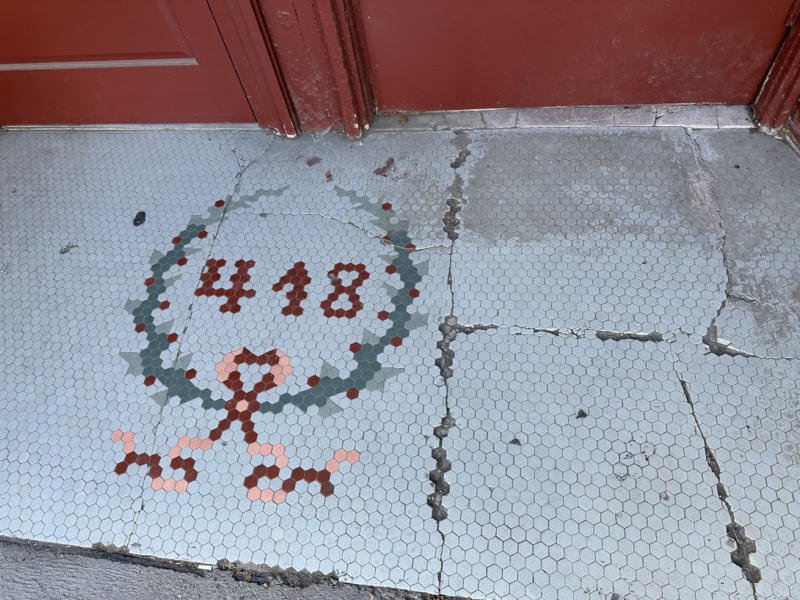 418 Eddy Street, Ithaca, New York, USA.
For anyone interested in the “pre-history” of our organization this address is significant. It was the setting for some of the events at the 1982 Summer Institute held at Cornell University, organized by the late Marjorie Grene and Dick Burian. Dick wrote about the importance of this meeting for what eventually became our organization as part of his tribute to Marjorie and included the participant and speakers list in it1. I was but a mere graduate student just ending my first year, but was keen to attend the public lectures given the focus on the challenges facing evolutionary theory, and the many luminaries including Stephen Jay Gould, who were invited as speakers. I never imagined that sitting in that small, cramped space in those rickety old chairs, that this meeting would become part of the foundational lore of our organization, or that our small community would grow as it did as an international society, with meetings in international locations every other year—but I doubt that any one thought that would happen at the time. It was a kind of experiment, embodying the vision that Dick, and especially Marjorie had of bringing philosophy into close promixity with biology, including history, and anyone in any area that could help solve some the problems in evolutionary biology at the time. The mix of the disciplines in the participant list reflected that.
And it worked, of course, becoming formally as our ISHPSSB later in 1989, so when I recently returned to Cornell for a research trip, I decided to pay homage to this special place. It was pretty much as I remembered it—charming, but run-down, and it was no exaggeration to describe it as “not exactly auspicious” as I did in my essay in the November 2023 issue of this Newsletter. It is located in an older section of Collegetown near the campus where time seems to have stood still, unlike other parts of the area so heavily developed that modern buildings now block the stunning sunsets on Lake Cayuga. I recognized the building instantly.
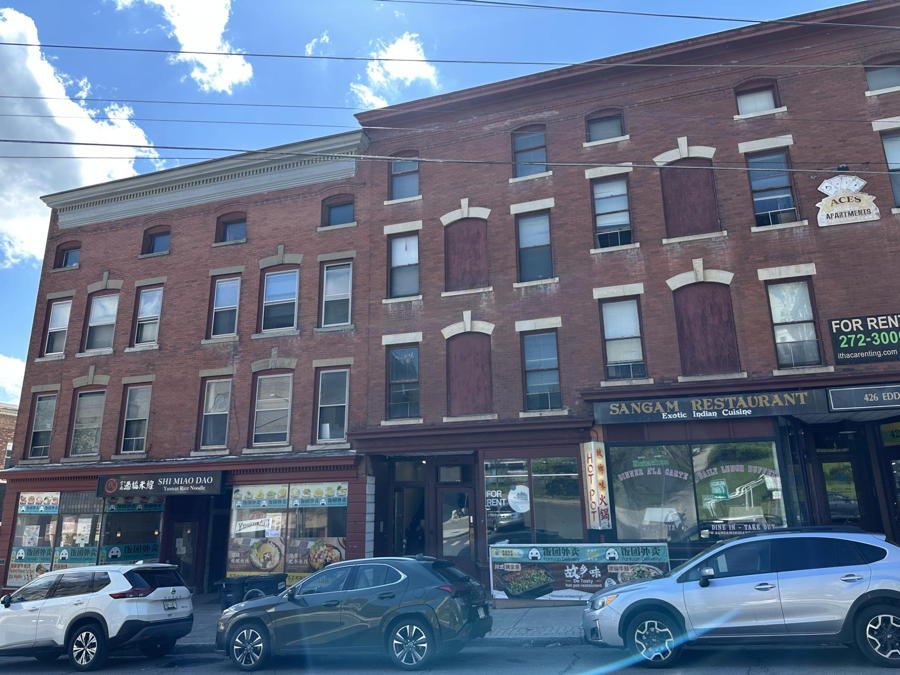
Little had actually changed on the exterior—the same red brick façade, with the same small narrow windows bringing in little daylight, the same row of parked cars immediately in front. Even the mosaic tiles at the central entrance with the numerals “418” were still there too, though showing more of the effects of wear and tear over the last forty-something years. Only the “grungy student pizza joint” had vanished, and still mourned by decades of past Cornellians who waited in line to feast on the stuff (you can't actually see the space in the photo because it was way down below in the basement of the building). And what once served as our lecture hall on one of the upper floors had been converted to a real estate office of some sort with apartments next door. Still, the place was intact and easily recognizable though many of the smaller shops and eateries had been replaced, so it brought back fond memories of the very early years of our society when it was still unusual, and very exciting to see the multidisciplinary and interdisciplinary mix of philosophers, historians, scholars in social studies of science in such a casual setting. Indeed, I think that first place in which this experiment was first attempted, probably set the tone for our subsequent meetings that continue the informal and relaxed style of interacting.
Betty Smocovitis
Past-President
1See Burian, R. Marjorie Grene: A Remembrance with Special Attention to Her Importance for ISHPSSB. Biol Theory 4, 183–187 (2009). https://doi.org/10.1162/biot.2009.4.2.183
An interview with Roberta Millstein about her book The Land Is Our Community: Aldo Leopold’s Environmental Ethic for the New Millennium
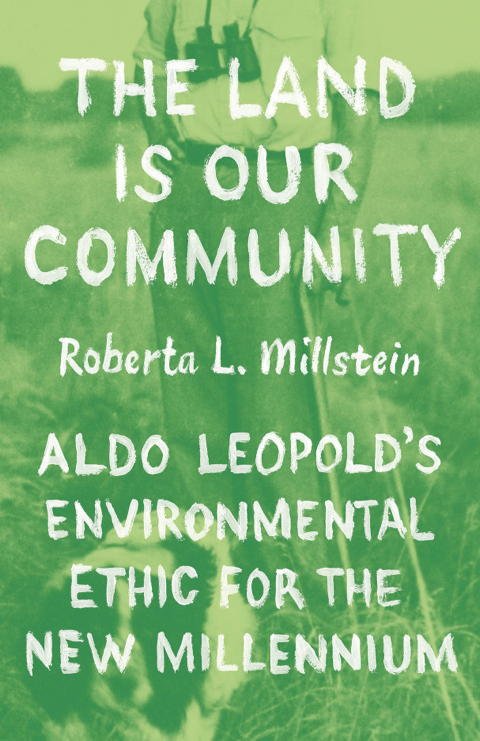
Brian McLoone (BM): One of the striking points you make in the book is that there are a number of "myths" about what Leopold thought. A lot of people have read (excerpts of) Leopold's /A Sand County Almanac (ASCA), but nothing else. Are there other works from Leopold that you think are hidden gems?/
Roberta Millstein (RM): The Aldo Leopold Foundation has made many of Leopold's works freely available, both in the original and in transcribed electronic forms (see https://www.aldoleopold.org/). Their site also has links to relevant books, including a number of volumes of collected essays. All of this was extremely helpful to me. This is my way of encouraging people to explore Leopold's writing outside of ASCA. There's a lot to look at and it is readily available. Dive in!
That being said, here are some of the essays that were particularly illuminating for me. His “Deer Irruptions” (published in Transactions of the Wisconsin Academy of Sciences, Arts, and Letters) showcases Leopold talking to other scientists, not the general public as with ASCA, and that gives a sense of his method and rigor, as well as the necessary change in tone and language he brought to his different works. (At the heart of the “myths” I identify is treating Leopold as though he were a philosopher writing to other philosophers, and reading him in a very literal way). From a scientific point of view, I gained an appreciation of the evidence he brought to bear on what became known as the “trophic cascade” between predators, their prey, and the plants consumed by those prey.
Several essays speak to his views on stability and land health, which for Leopold are virtual if not complete synonyms; one of the myths I discuss concerns the failure to appreciate his distinctive use of the term “stability”. These include “Land-Use and Democracy” and “Conservation: In Whole or In Part?”, both in the Flader and Callicott volume of collected essays. Reading Leopold's exploration of land health—what it means, what its symptoms are, what its causes and effects are—led me to appreciate that Leopold was offering a distinctive and fruitful way of thinking about a primary goal of his land ethic both from an ethical and ecological point of view.
BM: A key idea for Leopold was land "health." He thought the Sierra Madres were the healthy versions of comparable mountain ranges in Arizona and Nevada. Can you talk a bit about what Leopold meant by land health? And why is this a helpful concept (assuming it is)?
RM: In 1942, Leopold wrote: “Health expresses the cooperation of the interdependent parts: soil, water, plants, animals, and people; it implies collective self-renewal and collective self-maintenance.” The idea is that underlying the interdependencies between the parts of the land communities are the familiar ecological interactions such as predator-prey or parasite-host (in Chapter 2, I defend the claim that “negative” interactions like these can be the basis for interdependence) as well as other non-food-chain related interactions, such as the provision of shelter and shade. When these interactions are operating, nutrients and energy are passed among the members of the land community. This allows the community to persist, to self-renew, to continue to support a diversity of life over time. But when we make drastic changes to land communities, such as those that cause the extinction of species (especially key species like top predators) or that deplete the soil or lead to its erosion, the cycling of nutrients and energy cannot continue, and the land loses its ability to renew and persist. It becomes sick.
In the book, I talk about the relevance of his land health concept for thinking about a long-contested connection between biodiversity and stability. (The “Land Health” chapter of my book had its origins in an Ish presentation at the 2021 virtual meeting, “Aldo Leopold and the Biodiversity-Stability Connection”). I argue that his views help us to see biodiversity and stability in productive ways that shift us away from simplistic “numbers of species” or “equilibrium” (respectively), understandably pragmatic choices that have led to some dead ends.
From an ethical point of view, it gives us an achievable goal for our “restoration” efforts. We cannot put things back the way they were, and even if we could, with climate change it might be a mistake to do so. However, we can seek to make our land communities sustainable and thus healthy, understanding that we humans are parts of those communities too.
BM: My impression of Leopold is that he was a great ecologist, but a bit helpless when it comes to ethics. Please convince me I'm wrong. You describe Leopold's main argument for the land ethic as an argument from consistency. I understand the argument as follows. We treat other members of our community as worthy of ethical concern, and this includes humans and at least some non-human animals. But we are also in a community with (i.e., we are dependent upon) the "land," and so our moral concern should extend to the land as well. Two questions: What is "land" in this context? And aren't there important differences between, on the one hand, humans and non-human animals and (say) plants and streams? The former can reason and/or suffer, while the latter can't.
RM: One of the things I think is important to understand about Leopold's ethical thinking is that it came from a lifetime of hands-on experience. He underwent a considerable change in his ethics. For example, he originally championed the extermination of wolves, but by the end of his life, he not only saw them as essential members of the community but also thought that they had a right to continuance, period. (I discuss this change in belief in a PSA paper that is not in the book, “The coevolution of descriptive and evaluative beliefs in Aldo Leopold's thinking”). I think it's a “feature,” not a “bug,” that Leopold was an ecologist who let his experiences change and inform his values.
You've got the argument from consistency almost, but not quite right. Here is a version that better captures what Leopold was saying:
- Given interdependence between humans, we accept limitations on our actions (rules of conduct) to benefit and protect individual humans and human communities; our ethical theories capture these rules of conduct.
- However, history and ecology show us that we are not just interdependent with other humans, but that we are also interdependent with other species and with “abiotic” components such as soils and waters; together, we form land communities.
- Thus, consistency demands that we need to expand our ethics to include the land; we also need to accept rules of conduct that benefit parts of the land community (one's “fellow members”) as well as the community as a whole.
Interestingly, the arguments for extending our ethics to non-human animals have the same form. They are also arguments from consistency—see, e.g., Peter Singer, Tom Regan—but they differ in their first premise. As you can see, Leopold's first premise has to do with the origin of ethics in our interdependence. Singer and Regan rest the origin of ethics on capacities such as the ability to feel pain or to reason, arguing that since there are animals that have these capacities too, they are also part of our moral community. In all cases these premises are un-argued for; one has to start somewhere. Some people find the sentience a more “intuitive” first premise, but one of the (best, in my opinion) hallmarks of environmental ethics is the way that it challenges our intuitions, which after all may be based on cultural biases we're not even aware of. Certainly, Leopold knew better than anyone that he was trying to effect a very difficult change in values. Emphasizing our interdependence with other members of the land community—something that is easy to miss for city folk—throughout ASCA was one of the ways he hoped to bring about that change.
BM: The last chapter of the book is about policy implications. If you had to pick one contemporary policy implication that we can glean from Leopolod's land ethic—at whatever level of granularity you'd like—what would that be?
RM: One point I emphasize in this chapter is the extent to which Leopold's ethics are pluralistic. The land ethic extends our ethics to include obligations to land communities as a whole (i.e., promoting and protecting their health), but it does not replace our other ethical beliefs. In particular, individuals (both human and nonhuman) have value, but also, there are a whole host of anthropocentric values that Leopold mentions explicitly, including practical things like forestry and agriculture as well as aesthetic value. Leopold advocated for a “principle of integration of land uses” that would bring together people with different values, interests, backgrounds, and expertise, with a commitment to try to harmonize these different values and interests to the extent possible. Importantly, however, all needed to share a common commitment to the long term health of the land; indeed, that is the interest that all interests have in common, whether they recognize it or not.
There are so many domains where this is relevant, but I think I see its relevance most often in discussions of how to address the climate crisis. Because it is a crisis, I think there is a tendency to focus on what is most obvious to us, namely, the impacts on humans. And certainly, those are important, as Leopold would surely have agreed! But when we decide on various ways of mitigating climate change, we cannot lose sight of the impacts to land health. That means, for example, that there are better and worse places to put solar panels, with sensitive ecological areas (and yes, this can include deserts) typically not being a good choice. I could go on, but the general point is ensure that land health is preserved to the extent possible in all of the ways we try to address the climate crisis, or else we will simply replicate (and exacerbate) our existing crisis.
Announcements
Eco-Evo-Devo: The Environmental Regulation of Development, Evolution, and Health
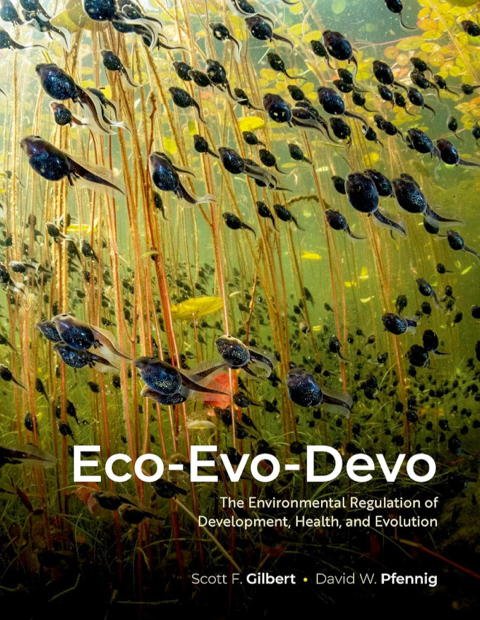
It is my pleasure to announce that a new evo-devo textbook will soon be available. It will even be more than evo-devo, as its name suggests: Eco-Evo-Devo: The Environmental Regulation of Development, Evolution, and Health. This book is a radical metamorphic molt of the Gilbert and Epel Ecological Developmental Biology. It shows how developmental biology, evolutionary biology, and ecology each form the context for studying the others. My new co-author is David Pfennig, a card-carrying evolutionary ecologist whose expertise is the evolution of plasticity. The book contends that the field of evolution must include a developmental framework which integrates population genetics with alternative inheritance systems, symbiosis, and plasticity.
Both the format and the individual chapters have been updated. Indeed, there are eight new chapters in the book. The initial chapters are mostly new and are introductions to the principles of development, evolution, and ecology. These should allow each student, no matter in which discipline they were originally trained, to take part in subsequent discussions. Plasticity and symbiotic relations during development are highlighted in these chapters and especially in the new introductory chapter. If species are united vertically by evolution and horizontally by ecology, developmental biology provides a third axis permeating them both.
The second portion of the book integrates these concepts to emphasize:
- the organism as an ecosystem (holobiont theory);
- heredity as the transmission of genes, epigenetic patterns, cultures, and even particular environments;
- evolution through developmental regulatory genes and symbiosis;
- phenotypic plasticity and evolution;
- the origins of complexity.
The third section of the book concerns the "downsides" of having such entangled systems of development: teratogenesis, endocrine disruptors, and the developmental origins of adult disease. The section ends with an assessment of what eco-evo-devo science can do to alleviate the biodiversity crisis. The last chapter, a coda, is an historical appendix describing the truncated traditions of eco-devo and its rebirth in the current century. It includes new material on Trofim Lysenko and Paul Kammerer, as well as other examples of practicing biology in periods of ideological conflict.
Over 50 years ago, Leigh van Valen wrote, "A plausible argument could be made that evolution is the control of development by ecology." This well-illustrated volume provides evidence for that argument. We think that Eco-Evo-Devo will show undergraduate and graduate students how developmental biology helps form a new evolutionary framework for the origins and maintenance of biodiversity.
An overview, description, table of contents (and incredibly beautiful cover) can be seen at the Oxford University Press website: https://global.oup.com/academic/product/eco-evo-devo-9780197664025
Scott F. Gilbert
Call for PIPOLS (People of the Italian Philosophy of the Life Sciences) workshop (ISHPSSB 2026 Off-Year Workshop Proposal)
Organisers: Federica Bocchi, Federico Boem, Thomas Bonnin, Stefano Canali, Emma Cavazzoni, Davide Serpico Keynote: Sabina Leonelli
PIPoLS (People of the Italian Philosophy of the Life Sciences) is the first Italian network that brings together scholars in the philosophy of the life sciences —broadly construed to include biology, medicine, psychiatry, etc.,— using methodologies that bridge the gap between empirical and theoretical research. The network has already attracted Italian and international researchers with institutional or intellectual links to Italy, and aims to create a space for the advancement of the philosophy of the life sciences, with a particular focus on scientific practices, the integration of empirical and historical methods, and inter- and trans-disciplinary methodologies. The network invites early-career researchers —PhD candidates and MA students,— to participate in the first workshop and send an abstract to be presented in one of the following formats: flash talks, posters, or short videos.
The workshop will be held on December 17–18, 2026 at Politecnico di Milano, thanks to funding from the International Society for the History, Philosophy, and Social Studies of Biology (ISHPSSB) as Off-Year Workshop and the Politecnico unit of the social sciences and humanities for science and technology (META). Alongside sessions dedicated to various philosophical aspects of the life sciences, as well as mentoring and community-building activities, the program will provide a platform for those interested in entering the world of research to present their ideas, projects and questions at the intersection of the philosophy of science, applied philosophy and related issues. Each junior presenter will have a 10-minute slot followed by 5 minutes of structured discussion and feedback. Roughly one month before the workshop, participants will have the opportunity to take part in a small group (or one-on-one) mentoring session with a more experienced researcher in the field aimed to support them in the development of their work-in-progress project. Selected participants will have the opportunity to apply for travel funding.
How to participate:
- Submit your 150 words abstract via Oxford Abstracts: https://app.oxfordabstracts.com/auth?redirect=/stages/82574/submitter
- CfP closes: July 19, 2026
- Notification of acceptance: September 2026
Contacts: Emma Cavazzoni (
Credits
This newsletter was edited by David Suárez Pascal employing GNU Emacs and Scribus (both open source and freely available). I thank Sabina Leonelli for proofreading it and all the ISH members who kindly contributed to this issue with their texts.
The logo of the society was generously contributed by Andrew Yang.
Submissions for the newsletter should be addressed at: